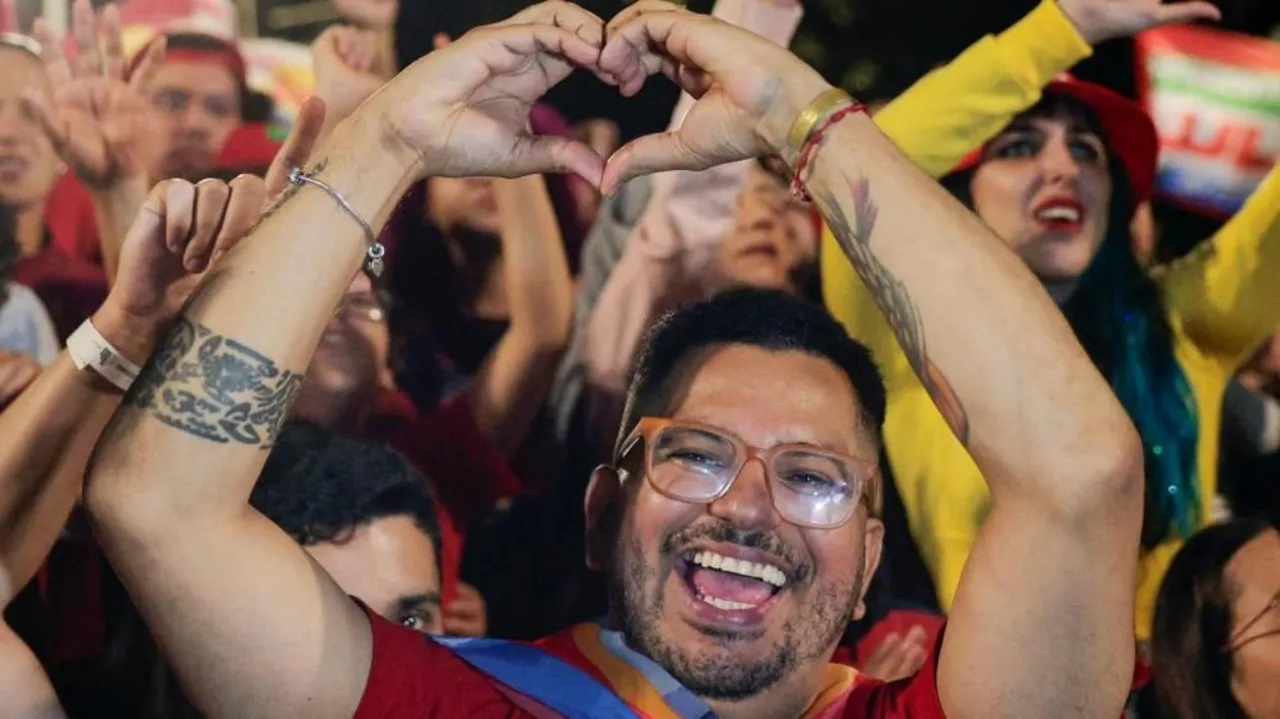
Luiz Inácio Lula da Silva has won a historic fourth term as Brazil's president, defeating far-right opponent Flávio Bolsonaro in a dramatic runoff election and vowing that dictatorship and fascism will never return to the country.
Lula secured 64.2 million votes to Bolsonaro's 59.8 million, a margin of 51.79% to 48.21% — more than four million votes. It was at least ten million more votes than Lula had received in the first round, which he had lost.
"Today is a historic day," Lula told tens of thousands of supporters gathered in central São Paulo in the early hours of Monday. "Democracy always, dictatorship never again. Democracy always, fascism never again."
Never since the return of democracy following the 1964–85 military regime had a first-round loser gone on to win the second vote. Lula did precisely that, prompting celebrations across São Paulo and cities throughout Brazil.
"This is God's work — and it's thanks to all of you," Lula told the crowd.
Flávio Bolsonaro rejected the result, calling Lula's victory "sacanagem" — a Portuguese word that roughly translates as "bullshit." His father, former president Jair Bolsonaro, had similarly refused to concede after losing the 2022 election to Lula and was later convicted of plotting a coup.
Political leaders from across the ideological spectrum were quick to recognise the result. Mexico's president Claudia Sheinbaum wrote: "Long live democracy, the people of Brazil won." Spain's prime minister Pedro Sánchez declared: "The global progressive resurgence has just begun." The UK's foreign secretary Ed Miliband called it "a historic win for the global progressive movement" and said his government looked forward to collaborating on "shared values of democracy, social justice and climate action."
European Commission president Ursula von der Leyen said: "Democracy and multilateralism have won in Brazil." A spokesperson for China's foreign ministry stated: "China respects the choice of the Brazilian people." Rightwing South American leaders also acknowledged the outcome, with Chile's president José Antonio Kast calling Lula to offer congratulations and Peru's president Keiko Fujimori saluting "the Brazilian people for this democratic day."
There was silence from Donald Trump, whose administration had been backing a Bolsonaro victory as part of what supporters described as a pro-Trump "orange wave" across the region. In the lead-up to the vote, the United States had been accused of seeking to influence the result through economic and diplomatic pressure.
Transgender lawmaker Erika Hilton, recently elected as the most voted-for woman in Brazil's congress, said those efforts had failed. "We have defeated the interference of the US government, which thought it could turn our country into its back yard. Brazil and the Brazilians are too gigantic to be anybody's back yard," she said.
Lula's health minister Alexandre Padilha described the result as significant beyond Brazil's borders. "It's a massive victory — not just for Brazil. It's also an important signal to the rest of Latin America and to the world," he said.
Climate activists also welcomed the result. Lula's previous time in power saw a record decrease in deforestation in the Amazon, the world's largest rainforest. On the eve of the vote, former environment minister Marina Silva had warned that Bolsonaro, if elected, would seek to finish what she called the "perverse project" of rainforest destruction begun under his father's 2019–22 administration, which coincided with a surge in deforestation.
The victory was also shaped by a significant shift in campaign strategy. Political scientist Denilde Holzhacker argues that Lula's comeback was driven not by online activity alone, but by combining digital campaigning with grassroots mobilisation. The campaign intensified local efforts and adapted its messaging, linking a Bolsonaro victory to potential cuts to social programmes and the erosion of rights.
A key figure in the digital effort was congressman André Janones, who organised a network of online supporters — dubbed "Lula's Army" — to amplify campaign content across social media and WhatsApp. Janones frequently instructed followers to share videos and push hashtags, and hosted a 24-hour live event on the eve of the election.
In his victory speech, Lula referred to Janones as "our General" and thanked him for "raising the morale of our troops every day."
Sociologist Mayra Goulart, a professor at the Federal University of Rio de Janeiro, cautioned against attributing the result solely to social media. "It was a combination of social media and street-level mobilisation," she said. "The physical world enabled a form of mobilisation capable of reducing abstention and persuading undecided voters."
Lula himself suggested the campaign's methods could shape his approach to governing. "We are going to give people a greater say in decision-making, and digital communication will play a much bigger role in my government," he said.


