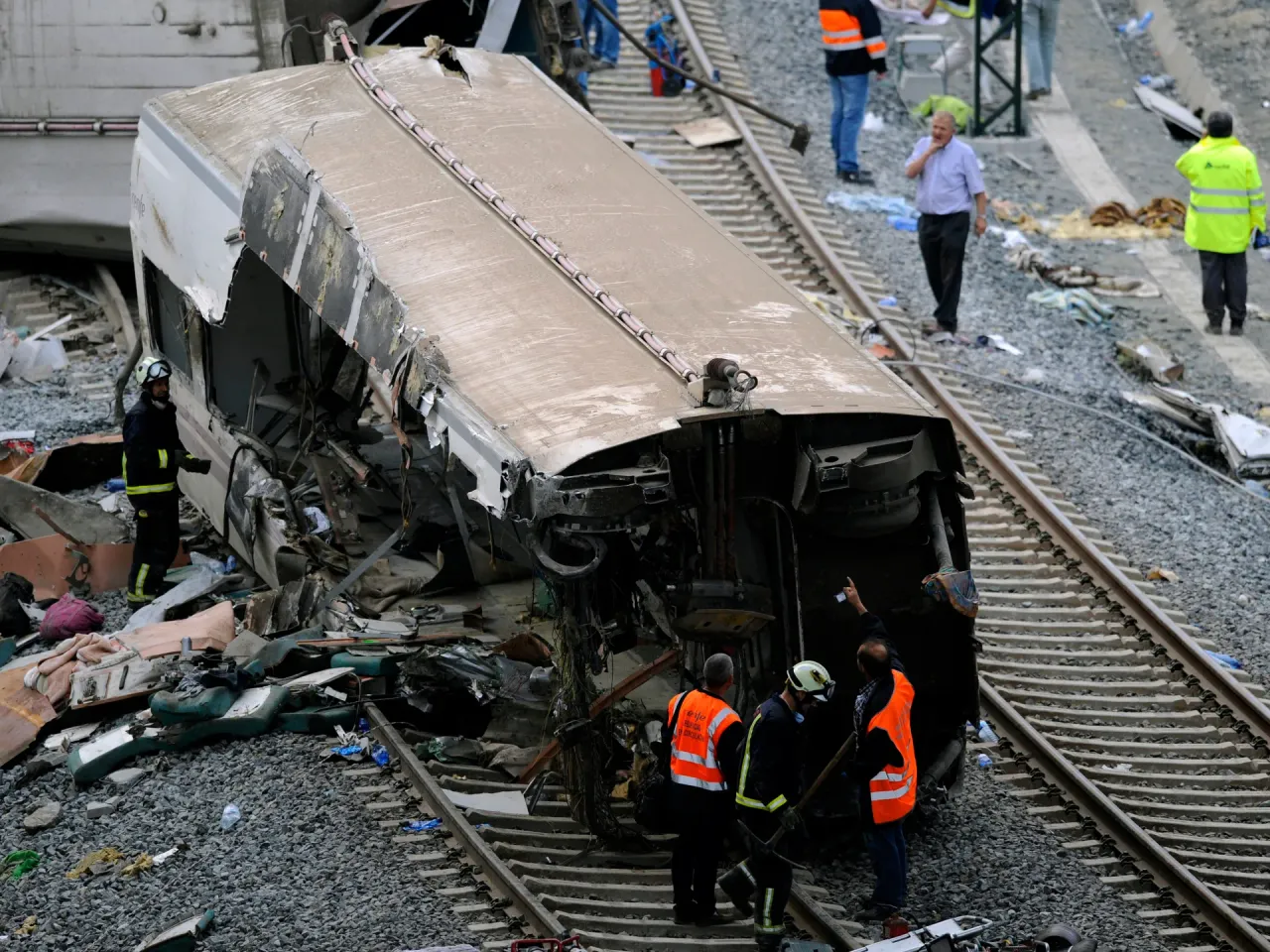
Spain is demanding answers after at least 69 people were killed when two high-speed trains collided near Urda, a town close to Toledo in central Spain, on Wednesday morning.
The crash occurred when a Renfe service ploughed into the back of a stationary train operated by private Spanish company Iryo. It is one of the deadliest rail disasters in Europe this century.
The collision comes only ten months after two trains collided on the same line near Adamuz, close to Cordoba in southern Spain, killing 46 people. An initial investigation into that crash found a broken rail had caused one train to veer off the line into the path of an oncoming train.
Distraught relatives have been desperately seeking news about their loved ones. Scores more passengers were injured in Wednesday's collision.
Spanish newspapers captured the national mood on Thursday. El Mundo's front page lamented "Another massacre on the trains." ABC noted "At least 68 dead nine months on," while El País mourned the "Second high-speed catastrophe in less than a year."
Survivors of Spain's worst rail disasters have called for urgent action. Cristobal Gonzalez, 64, a retired army captain, was injured in Spain's deadliest rail crash, at Angrois near Santiago de Compostela in 2013, when a high-speed train travelling at 200 kilometres per hour — more than double the permitted speed — derailed, killing 80 people. He still suffers from post-traumatic stress.
"I survived but the mental scars are still there all these years later. We must stop more accidents happening," Gonzalez said.
"Now we have seen three dreadful crashes in Spain, at Angrois, Adamuz and Urda. They will keep happening if we do not act," he added. "At Angrois, the driver was going too fast; at Adamuz, an investigation said there was a problem on the track; and at Urda it might have been human error and a problem with the control system. Whatever, we must stop these crashes happening by investing more in safety."
Santiago Rosendo, a passenger on the Renfe train involved in the Adamuz crash in January, described the moment of impact. "There was a sudden stop — a very sudden stop — then following that, a loud crash. Then the train moved from side to side until the train slid onto its side and we were left entirely in the dark. The first thing I saw when I got off the train was a body," he said.
"I cannot believe that this has happened again on the same line. We have to do something," Rosendo added.
Experts have called for greater investment in rail maintenance. Between 2018 and 2022, Spain spent an average of approximately 1.67 billion dollars per year on its high-speed network — more than comparable European countries. However, according to European Commission data, only 16 percent of that spending went toward maintenance or repairs, with the remainder devoted to infrastructure expansion.
By contrast, Italy, Germany and France each spent between 33 and 39 percent of their rail budgets on maintenance during the same period, despite operating smaller networks than Spain's 4,000-kilometre system.
Jose Maria Goicolea, spokesman for the Spanish Association of Civil Engineers, said that with growing use of the rail network, "there has to be more spent on maintenance."
The disaster has also landed at a politically sensitive moment. Spain is heading into a snap general election called by Prime Minister Pedro Sanchez after rightwing and far-right parties voted down housing reforms his coalition government had proposed in response to public protests.
The crash has, for now, subdued much of the heated rhetoric that has characterised the campaign. It also threatens to overshadow Sanchez's efforts to defend his record in office.
Sanchez has described it as "unacceptable" for Spain to experience two high-speed rail disasters in less than a year and has promised to strengthen safety measures "so that something like this never happens again."
Opposition People's Party leader Alberto Nunez Feijoo visited the crash site on Thursday and said any politician found responsible would be held to account. "We can't go on like this; this kind of management just can't carry on," he said.
The far-right Vox party went further, accusing the government of "killing" the victims and urging the supreme court to investigate Transport Minister Oscar Puente on suspicion of manslaughter and causing bodily harm through gross negligence. Puente has rejected allegations of mismanagement.
Political scientist Pablo Simon, of Carlos III University of Madrid, said the accident had a dual impact. "First, it draws attention to the state of railway infrastructure, suggesting that the problem is structural, and pointing to a broader decline in public services in Spain, specifically regarding infrastructure," he said. Simon added that the government, in power since 2018, could not credibly attribute the current state of the network to austerity cuts made by its predecessor.
Spain's high-speed rail network has long been a source of national pride and is used by millions of people for work, travel and family visits. Wednesday's disaster has left the country in shock and grief.