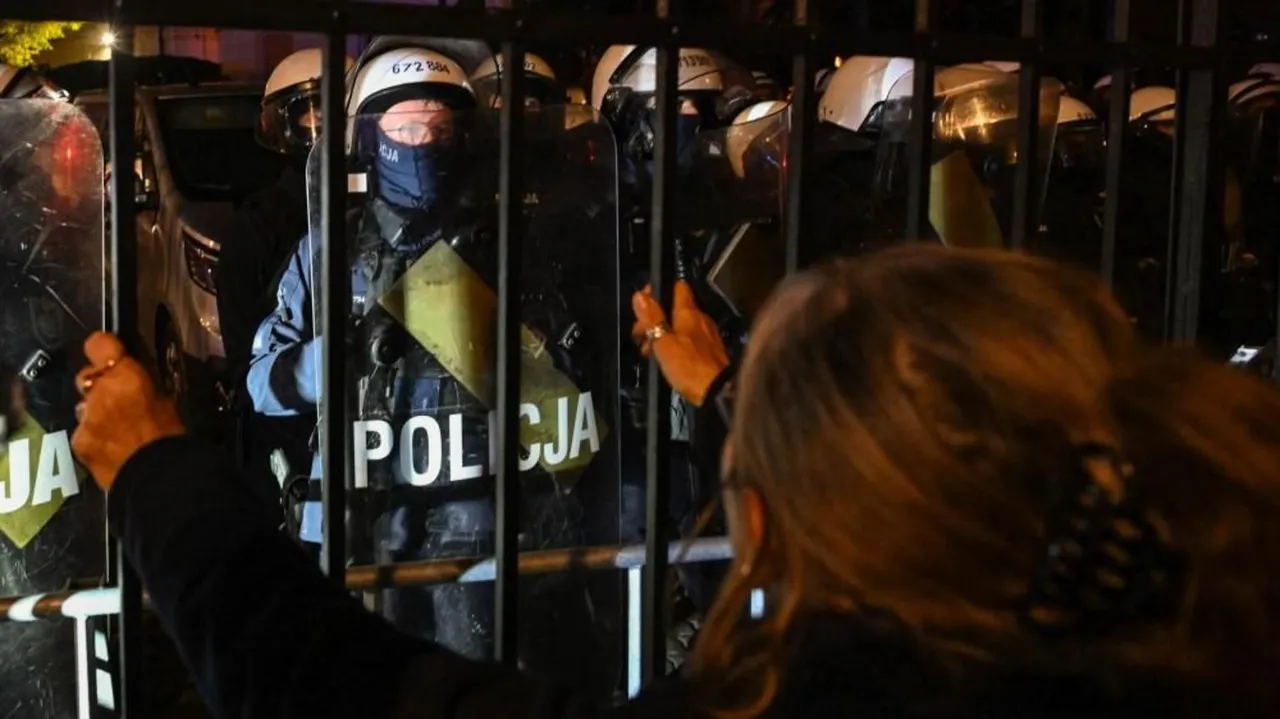
Riot police were deployed outside Poland's Constitutional Tribunal in Warsaw on Friday night after a group of government-appointed judges suspended the court's contested president, Bogdan Swięczkowski, and his deputy, Bartłomiej Sochański, in the latest escalation of a decade-long dispute over the court's legal status.
Hundreds of protesters, including opposition members of parliament, gathered outside the building in support of the suspended judges. Police said they detained three people after some protesters breached the tribunal's fence and threw objects at officers.
Polish President Karol Nawrocki, who is backed by the opposition Law and Justice party (PiS), turned his plane around mid-flight while en route to a sporting event in Senegal to return to Warsaw. Shortly before 1am on Saturday, Nawrocki appeared outside the court and forced his way through the police cordon into the building. As of 4am local time, he remained inside. In a statement read on his behalf at 5am, Nawrocki condemned what he called "a violation of Poland's constitutional order", saying "a constitutional body was seized by force", and called for security forces to leave the premises.
In a video posted online, Nawrocki was heard saying the government-appointed judges "were not judges of the constitutional court."
PiS leader Jarosław Kaczyński condemned what he described as an "assault" on the court. Former Justice Minister Zbigniew Ziobro wrote on social media: "This is a blatant, criminal attack on the constitutional order."
The Constitutional Court itself posted on social media that the two suspended judges remained the legally appointed senior justices of the court. "All persons participating in these actions are committing the crime of a coup d'etat," it said.
Prime Minister Donald Tusk defended the move. "Restoring the rule of law is our duty. After years of Law and Justice's lawlessness, this is a difficult, sometimes painful process that requires decisive action. There is no other way," he wrote on social media.
Justice Minister Waldemar Żurek said he had requested that Swięczkowski and his deputy's immunity be lifted for failing to fulfil their duties by preventing newly elected judges from performing their work.
Anna Korwin-Piotrowska, one of five judges elected by the current parliamentary majority whom Nawrocki had refused to swear in, declared she had assumed the top position at the court, citing her longest experience in the judiciary.
The dispute over the court dates back to 2015, when the outgoing centrist government and the incoming PiS administration made legally questionable moves in quick succession to stack the bench with their respective appointees. The PiS-led government, which held power from 2015 to 2023, moved swiftly to appoint judges and gain a majority on the court, which holds the power to rule on the legality of legislation.
Leading European courts, including the European Court of Human Rights and the Court of Justice of the European Union, subsequently ruled that three of the PiS-appointed judges had been elected improperly, as they duplicated positions already validly filled by the previous parliament. The European courts ruled that Poland's Constitutional Court was no longer an "independent and impartial tribunal." Tusk's government has used those rulings as a basis to stop publishing the tribunal's decisions.
Since returning to power in 2023, Tusk has repeatedly pledged to reverse the PiS-era judicial reforms and restore relations with Brussels. His efforts have been blocked by opposition-aligned presidents, who used their veto powers to prevent reform legislation from passing.
Nawrocki, who unexpectedly won last year's presidential election against Tusk's candidate, has refused to swear in judges elected by the current parliament — sources put the number at either five or six, depending on the account — citing alleged flaws in their selection procedure. Earlier this month, the Council of Europe's advisory body on constitutional matters, the Venice Commission, said the president's refusal should not prevent the judges from taking up their posts and called on Nawrocki to swear them in.
Over the past six months, Swięczkowski used his authority as court president to block those judges from assuming their duties.
Legal experts are divided over the legality of Friday's suspension. Prominent law professor Marcin Matczak, an outspoken critic of PiS-era judicial reforms who has described Swięczkowski as the court's worst president, nonetheless said the legal basis for the suspension was "non-existent" and that he "did not think he would ever end up defending" Swięczkowski.
"Today's action at the Constitutional Court, in my opinion, buries this body and the issue of the rule of law for two decades," Matczak wrote on social media. "Images of armed police and legal interpretations according to which the minister of justice can remove the president of the Constitutional Court by decree will have a powerful, anti-rule of law backlash for years to come," he added.
Tusk has also faced criticism from within his own camp. Some supporters have accused him of failing to act decisively enough to reverse PiS-era reforms, while others have questioned his decision to nominate a politician, Maciej Berek, a lawyer who served as a minister in his cabinet, as a judicial candidate to the court.
Parliamentary elections are scheduled for next year. The latest confrontation is expected to further polarise the country, with polls showing the populist right with a chance of returning to power.