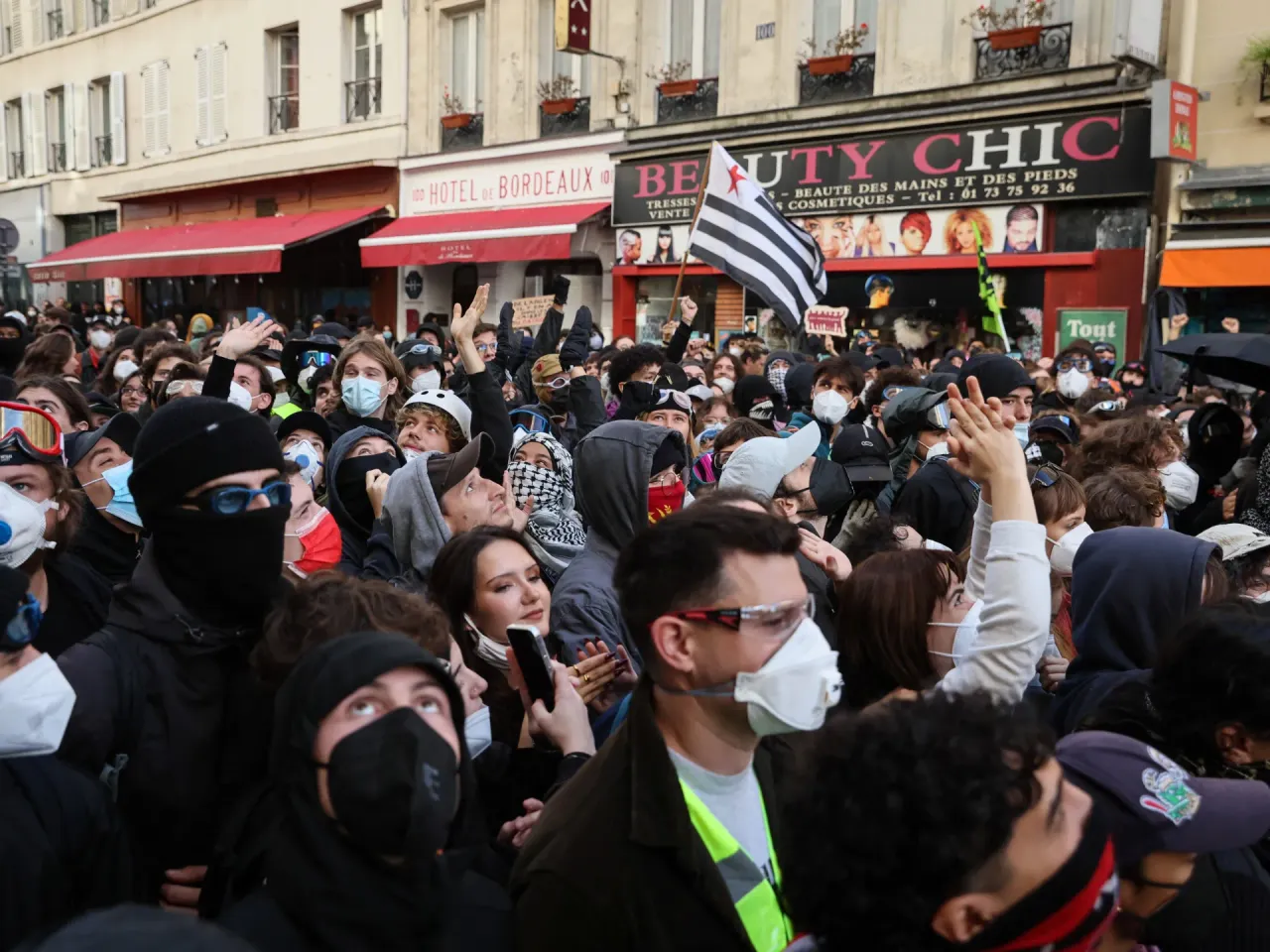
Mass demonstrations swept across France on Saturday, bringing together high school students, trade unions and "yellow vest" activists in a nationwide day of protest against the cost of living, social inequality and a deteriorating education system.
More than 600 demonstrations were planned across the country, according to protest organisers. Authorities estimated that nearly 200,000 people would attend, with around 40,000 expected in Paris alone.
The protests mark a significant escalation of unrest that began in mid-September at a high school in the Paris suburb of Creteil, where students took to the streets over dilapidated buildings, overcrowded classrooms and teacher shortages. Since then, the movement has spread to thousands of upper secondary schools across the country.
Trade unions, university students and remnants of the "yellow vest" movement, which staged mass weekly protests from November 2018 to June 2020, have joined the student demonstrations. The yellow vests initially mobilised against rising fuel prices before broadening their demands to encompass the high cost of living and economic inequality.
"High school students are fighting for their future. Workers are fighting to earn a living from their labour. Retirees are fighting to preserve their dignity. Our paths may differ, but our concerns can converge," Jerome Rodrigues, a prominent "yellow vest" activist, said in a video message released ahead of Saturday's demonstrations.
Jean-Luc Melenchon, leader of the hard-left France Unbowed party, marched in one demonstration earlier in the week. The government has accused the party of inflaming the protests, an allegation the party has denied.
In Paris, police banned rallies near the Elysee presidential palace, the prime minister's office and the Champs-Elysees avenue. A march through the city centre was also prohibited. The main Paris demonstration was scheduled to begin at 2 p.m. local time at the Place de la Republique.
Clashes broke out in several locations. In Paris, riot police confronted protesters in the Saint-Denis area on the outskirts of the capital and near the Gare du Nord train station. In both Paris and Marseille, police fired tear gas at demonstrators. Fires were set and protesters targeted a police station in Marseille.
Authorities described the broader wave of unrest as among the most violent in decades. More than 900 police officers have been injured since the protests began in mid-September. The internal police watchdog is investigating at least two dozen cases of alleged police violence.
More than 6,700 minors had been taken into police custody since mid-September, according to reports published this week. Human rights lawyers said several teenage students suffered serious injuries. Two cases drew particular attention: a 15-year-old lost his hand in the explosion of a stun grenade outside a school in the northern city of Lens, and a 16-year-old in Tours lost his sight after being struck by a rubber bullet.
While authorities suspended the use of stun grenades during student demonstrations, Interior Minister Laurent Nunez said on Friday that he had authorised police to deploy them in the event of what he described as "urban violence." Nunez also said he was expecting a "fairly significant" turnout.
President Emmanuel Macron called for "calm and respect" ahead of the protests, saying the right to demonstrate went hand in hand with "respect for people and property."
Prime Minister Sebastien Lecornu acknowledged the depth of public frustration. "This is a moment of fatigue in the country," he said on Thursday. "We are in an atmosphere of perma-crisis: wars, inflation and issues surrounding purchasing power."
Jordan Bardella, head of the far-right National Rally, which is leading polls ahead of next year's presidential election, expressed alarm. "I'm extremely concerned," he said during a visit to the Paris car show. "It will be a day of chaos for France."
The government has attempted to ease student anger by scrapping plans to increase some higher education registration fees, promising to deploy 3,000 substitute teachers to high schools and launching a national online survey to gather pupils' concerns. Critics argue the measures do not address the deeper structural problems within the education system.
The scale of Saturday's mobilisation is widely seen as a key indicator of the social climate ahead of elections to replace President Macron.