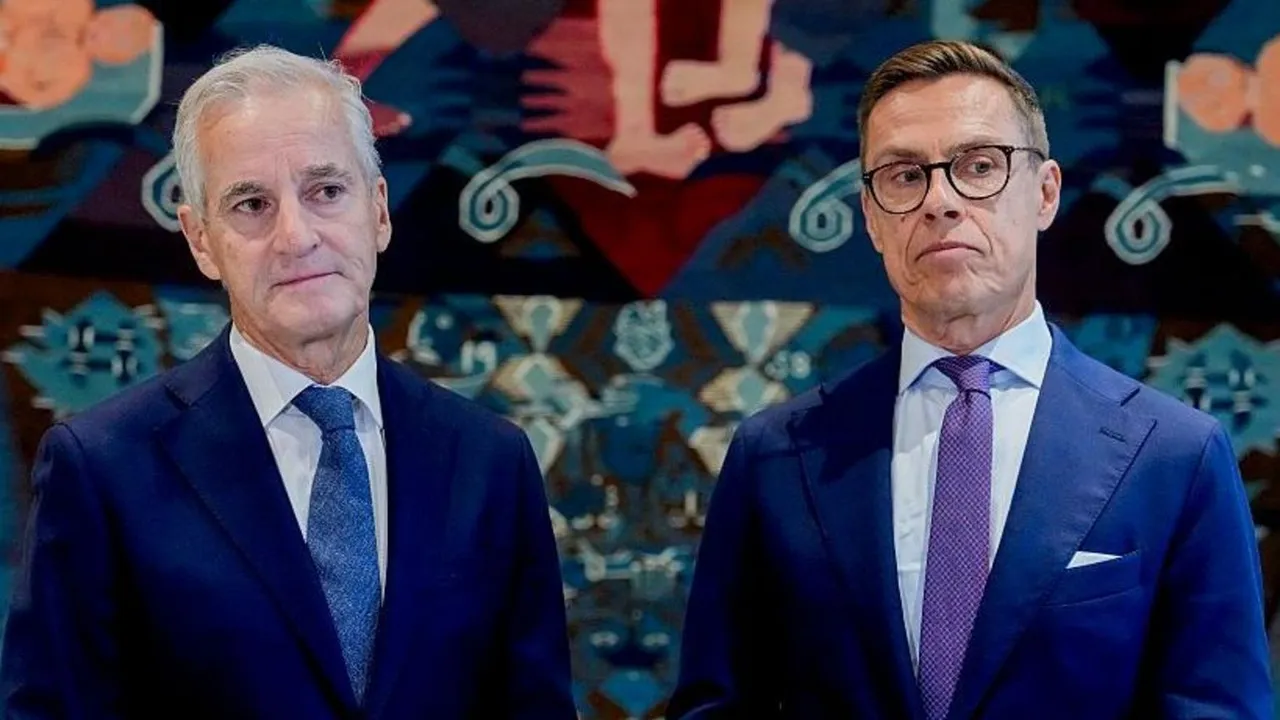
The leaders of Finland and Norway held a rare 90-minute phone call with Russian President Vladimir Putin on Tuesday, marking the first direct contact between the Russian leader and Western European heads of state since French President Emmanuel Macron spoke with him in July 2025.
Finnish President Alexander Stubb and Norwegian Prime Minister Jonas Gahr Støre initiated the call from Helsinki to discuss Russia's war against Ukraine and diplomatic efforts to end it. Both leaders stressed they were acting in their individual capacities as heads of neighbouring states, not as representatives of Europe as a whole.
"We've not set out to speak on behalf of anyone other than ourselves," Støre said.
Stubb described the conversation as "frank and substantive" but Støre acknowledged that "big differences in views" remained with Putin. "An end to the conflict in Ukraine will not be achieved through silence," Stubb said.
The call was prepared in consultation with Ukraine and the United States, following a meeting in Oslo on 20 October between Ukrainian President Volodymyr Zelensky, Nordic leaders and US special envoy Steve Witkoff. Stubb said Ukraine had itself sought the opening of a new channel of communication with Moscow.
The first trilateral US-Ukraine-Russia talks since the start of the year are tentatively planned for early November in Abu Dhabi. The Nordic leaders said Tuesday's call was directly linked to those upcoming negotiations.
Zelensky confirmed he was briefed by Stubb and Støre after the call and said he was grateful for their "active support." His Foreign Minister Andrii Sybiha described the call as "the right approach." Zelensky wrote on social media that Stubb and Støre had "clearly conveyed to the Russian leadership the need for genuine steps towards de-escalation, particularly when it comes to our energy sector and infrastructure."
The Kremlin's summary of the conversation indicated Putin maintained a firm position. "A fair long-term peace settlement is possible only if Russia's legal interests are taken into account fully and unconditionally," Putin said. The Kremlin also referenced what it described as "the confrontational policies of EU and NATO countries, which are contributing to the prolongation of the hostilities."
Kremlin spokesman Dmitry Peskov described the talks as "very constructive and practical" while noting that Moscow did not view the two Nordic leaders as speaking on behalf of Europe. Russian Foreign Minister Sergey Lavrov, however, said the call offered "nothing new" toward ending the conflict.
All three parties reportedly agreed to continue direct phone communication.
The call comes amid a broader shift in the diplomatic landscape. US President Donald Trump has increasingly aligned with Moscow, and European leaders have been largely sidelined from US-led peace negotiations. Trump struck a deal with Putin to release Russian diesel stocks to US and global markets despite existing sanctions on Russian oil, and waived newly approved US sanctions on Russia, drawing anger across Europe and within his own Republican Party.
US ties with Ukraine have deteriorated sharply. Ukraine also accused the United States of restricting its access to Starshield, the military-grade satellite system providing missile guidance intelligence.
An Austrian political analyst, Gerhard Mangott, said European governments had "manoeuvred themselves into a dead end" on the war and that Tuesday's call was an effort to establish a channel for dialogue.
There was no official EU reaction to the talks. The Danish and Swedish prime ministers said the dialogue had not been coordinated with other European leaders. Swedish Prime Minister Ulf Kristersson commented: "I think Europe should stick together rather than going solo." Polish Prime Minister Donald Tusk said Stubb had informed him that Europe's position on the upcoming Abu Dhabi talks was "moderately optimistic."
Stubb and Støre are the first European leaders to contact Putin directly since Macron's call in July 2025. After that conversation, Putin visited Alaska for a summit with Trump, after which Europeans were further sidelined from Ukraine peace talks.
Meanwhile, a local ceasefire in the Russian-occupied southern Ukrainian city of Oleshky appeared to be holding on Tuesday, with both sides halting drone attacks to allow the evacuation of between 1,500 and 2,000 trapped civilians. The temporary truce, which began at 3am local time, was due to last until 11pm on Sunday, Ukrainian officials said.
Residents of Oleshky have been living under a complete blockade. The last food delivery to stores was in May, and many people are reported to be starving. Some residents managed to escape on foot or by bicycle past bodies lying in the streets.
The ceasefire did not extend to other parts of Ukraine. Overnight, Russia struck Kyiv with drones and ballistic missiles, killing at least one person and injuring 15. Strikes hit a university campus, a bridge over the Dnipro River and metro infrastructure. Ten other regions also came under fire.