European Commission President Ursula von der Leyen has proposed making Canada the European Union's first associate member, a landmark overture that comes as U.S. President Donald Trump's tariffs and repeated talk of annexing Canada as a "51st state" push Ottawa closer to Europe.
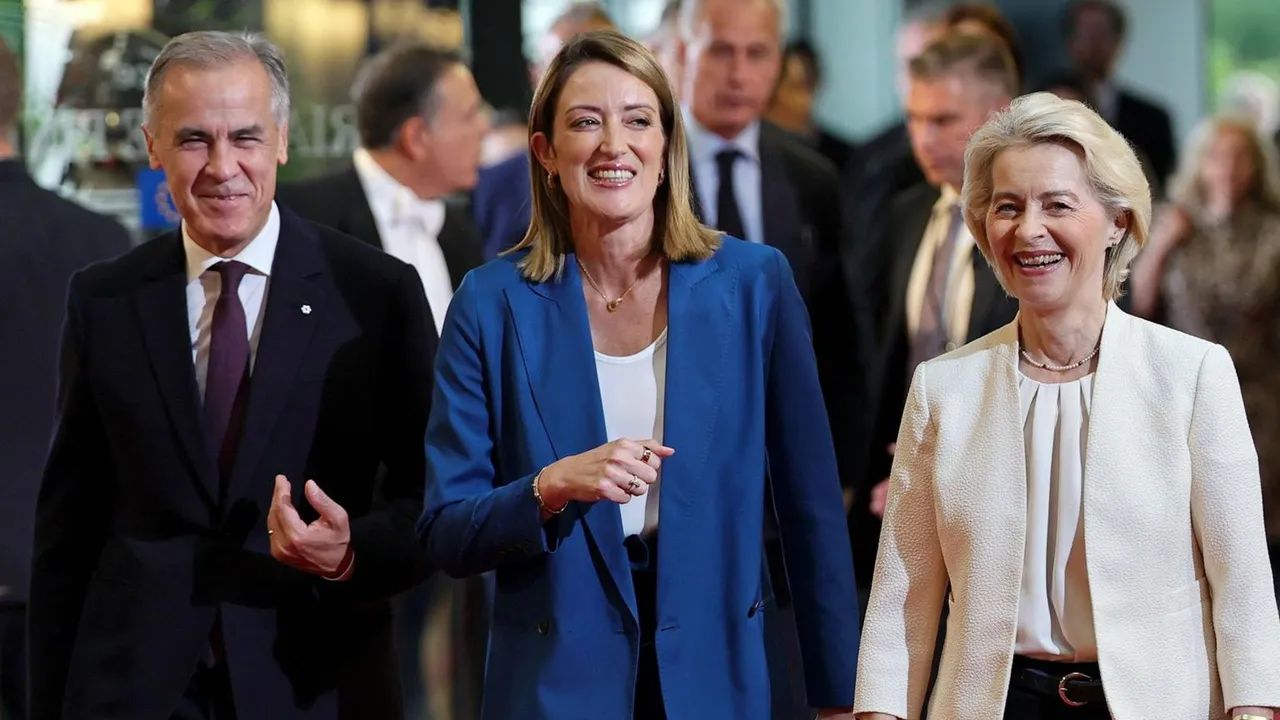
Von der Leyen made the proposal during her annual State of the European Union address at the European Parliament in Strasbourg on Wednesday, with Canadian Prime Minister Mark Carney seated in the front row.
"I would like to work with you on opening the door for Canada being the first associate member of the EU," von der Leyen told Carney directly. Carney rose from his seat, embraced von der Leyen and kissed her on both cheeks as lawmakers gave a standing ovation.
Von der Leyen framed the proposal as rooted in shared democratic values rather than opposition to any third party. "This is a partnership not against anyone else, but for our common strength," she said. "In short, we want to bring the relationship with Canada to the highest level possible."
She also said: "Above all, dear Mark, Europe and Canada believe in democracy. We believe that power does not belong to the strongest, the richest or the loudest, but to all of us."
The proposed expanded partnership would cover advanced manufacturing, technology, defence production, the Arctic, energy, critical minerals, batteries, artificial intelligence, quantum computing, cybersecurity and economic security. Von der Leyen described the broader framework as an "Alliance for the Future" aimed at creating "a common prosperity and economic security space."
Carney's office welcomed the proposal, saying Canada was deepening ties with the EU "to strengthen our sovereignty" and supported moving beyond their existing free trade agreement, known as CETA.
Roughly 70 percent of Canadian exports go to the United States. Carney has called for a "unique alliance" with the EU as Canada seeks to reduce that dependence. Trade talks between Canada and the United States collapsed last month, sparking a series of new tariff measures.
A Canadian official familiar with the discussions said last week that Ottawa was exploring ties with the EU that could stop just short of full membership. The official said Canada would seek an arrangement allowing its citizens to live and work in Europe without visas as part of a broader strategic partnership.
Carney is due to address the European Parliament on Thursday. He said on Tuesday that discussions would accelerate at the Canada-EU summit in Montreal in late October.
Canada this year became the first non-European country to join the EU's 150-billion-euro defence procurement program, known as SAFE, giving Canadian companies access to joint procurement.
However, associate membership of the EU does not currently exist, and the process, if agreed, could take years. Von der Leyen gave no details of how the arrangement would work or how it would fit alongside countries already negotiating full EU membership.
Ten of the bloc's 27 members have yet to ratify the existing free trade agreement with Canada, struck nearly a decade ago. Some capitals would prefer to build on existing defence and trade agreements rather than create a new form of membership.
Earlier this year, Germany's Chancellor Friedrich Merz suggested, to a mixed reaction, that Ukraine could be granted a similar associate status. Countries in the western Balkans, including Albania, Bosnia and Herzegovina, Montenegro, North Macedonia and Serbia, are already on the long road toward full EU membership. Georgia and Moldova are also applying.
Without naming Trump, von der Leyen said the proposal was "not a partnership against anyone else, but for our common strength," adding: "Partnerships are a strategic choice for Europe. But they also respond to the fracture in the international rules-based system."
In the same address, von der Leyen proposed the formation of a European Security Council that would include the United Kingdom and Ukraine. "This is even more urgent now, given the nature and scale of the risks at play," she said. "This is why we will set out our ideas to make a European Security Council a reality."
Other proposals in the wide-ranging speech included inviting the world's largest artificial intelligence laboratories for talks on supporting industry, reducing bureaucracy for businesses, a new emergency tool to help member states manage mass migration movements following the deadly influx of migrants to the Spanish enclave of Ceuta in July, and plans to ban social media platforms for children under 13. Under the proposed rules, children aged 13 to 15 would only be able to create accounts supervised by parents.