Bulgaria's presidential election is heading to a second round after no candidate secured the required majority in the first round on Sunday, with voter turnout falling far short of the 50 percent threshold needed for an outright result.
None of the 27 pairs of candidates competing in the first round won more than half of valid votes. Incumbent President Iliana Yotova received 34.7 percent of the vote, while former caretaker Prime Minister Andrey Gyurov came second with just under 32 percent. The two will face each other in a run-off on November 1.
Voter turnout was reported at 15.1 percent by 3 p.m. local time, according to one polling agency, while another source placed it at 22.2 percent as of 9:30 a.m. local time on Monday. Both figures fall well below the 50 percent participation required for a first-round result.
Minister of Interior Ivan Demerdzhiev said the vote "took place peacefully, without the usual practices of vote buying and vote manipulation."
A run-off had been widely expected ahead of the vote. The Bulgarian constitution requires both a turnout of at least 50 percent and a candidate winning at least 50 percent of votes cast for a first-round victory.
Yotova, 62, took over the presidency earlier this year after then-President Rumen Radev stepped down to lead his Progressive Bulgaria party in parliamentary elections. She previously served as vice president and is also a former member of the European Parliament and a journalist. She ran as an independent with the backing of both Progressive Bulgaria and the Socialist Party.
Yotova favors dialogue with Moscow as a path to peace in Ukraine and opposes military aid to Kyiv. A victory for her would also make her Bulgaria's first elected female president.
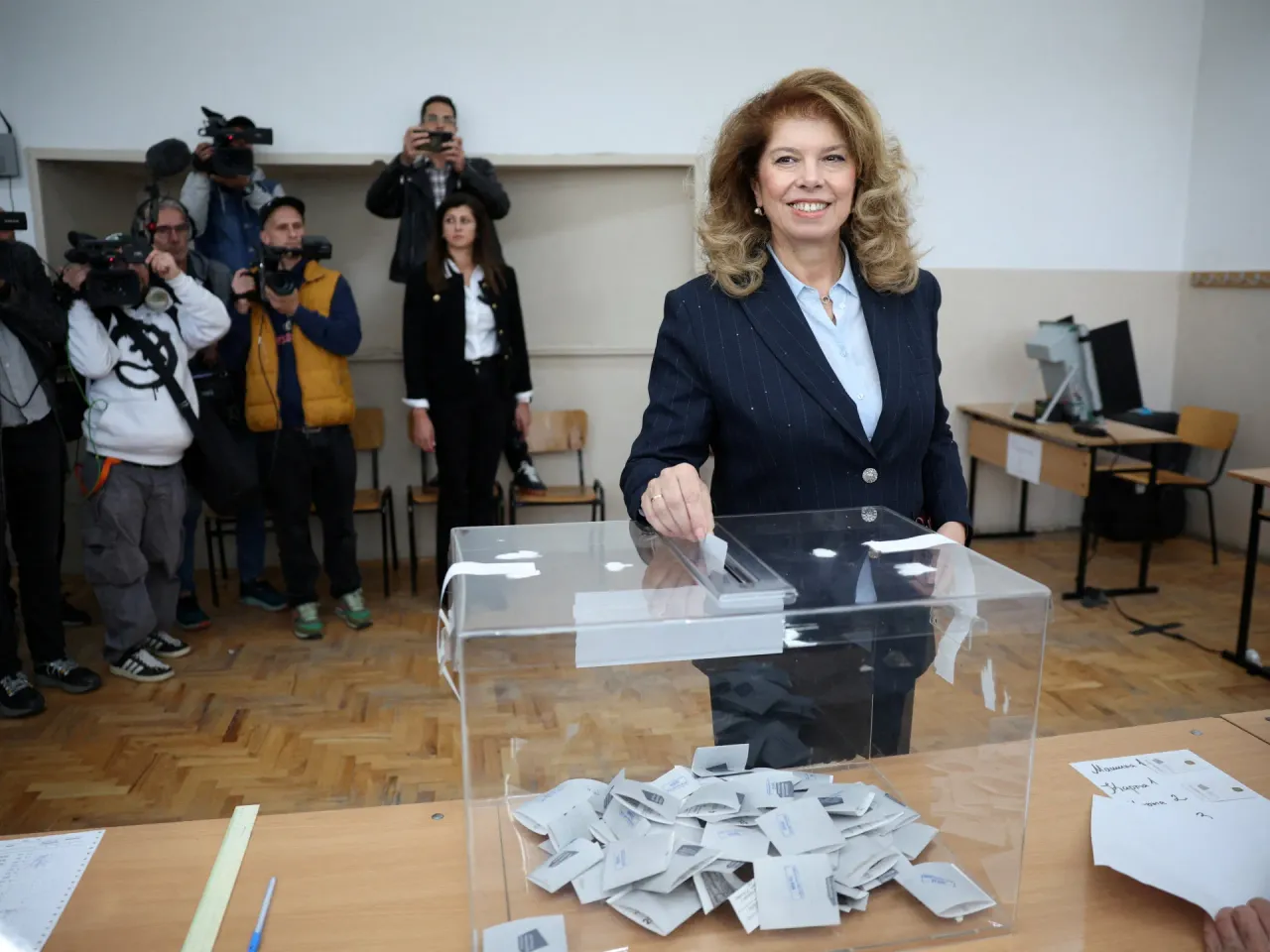
After casting her ballot in Sofia, Yotova called for peace, stability, and unity. "I believe that there must be peace, stability, and security," she said. She also said she wanted to address "the dire issue of poverty", as well as "inequalities and regional disputes."
Gyurov, 50, is backed by the country's pro-Western opposition. As caretaker prime minister, a post he held from February to March 2026, he signed a security cooperation agreement with Ukraine. He is an outspoken critic of Radev's foreign policy and strongly supports Bulgaria's Euro-Atlantic ties.
Gyurov voted in Blagoevgrad and called for a Bulgaria that looks ahead and offers families greater economic security. "I believe in a Bulgaria that looks forward, a country that is European, free, and proud," he said after the vote. He also invited Yotova to a debate before the second round, saying: "Next week, Bulgaria must choose between two personalities, two directions."
The leader of the pro-Russian far-right Vazrazhdane party, Kostadin Kostadinov, finished third with between 10 and 13 percent of the vote, according to pre-election surveys. Nearly half of the 27 candidate pairs were described as openly pro-Kremlin.
The major issues in the campaign included Russia's war in Ukraine, rising energy costs, inflation, and government corruption. Bulgaria is the European Union's poorest member state, and many voters expressed a desire for stable governance after years of multiple elections and coalition breakdowns.
The conflict in Ukraine became particularly tangible for Bulgarian voters after four merchant ships were reportedly struck by drones off Bulgaria's Black Sea coast this month, in what is suspected to be spillover from the war. The attacks prompted Bulgaria to seek assistance from allies to strengthen maritime security. Satellite internet antennas linked to the Starlink network were also set on fire near the capital, Sofia.
Both presidential candidates condemned the Black Sea drone strikes. While Prime Minister Radev said the attacks appeared to benefit Russia and summoned the Russian ambassador, his government stopped short of directly blaming Moscow.
Although the Bulgarian presidency is largely ceremonial, the head of state holds significant powers, including command of the armed forces, the ability to veto legislation, the authority to sign treaties, and the power to appoint interim governments during political crises.
The run-off vote is scheduled for November 1.