Violent clashes between anti-government protesters and riot police erupted in central Tirana for the fifth consecutive day on Saturday, as demonstrations that began in the summer continued to escalate into a broader movement demanding the resignation of Prime Minister Edi Rama.
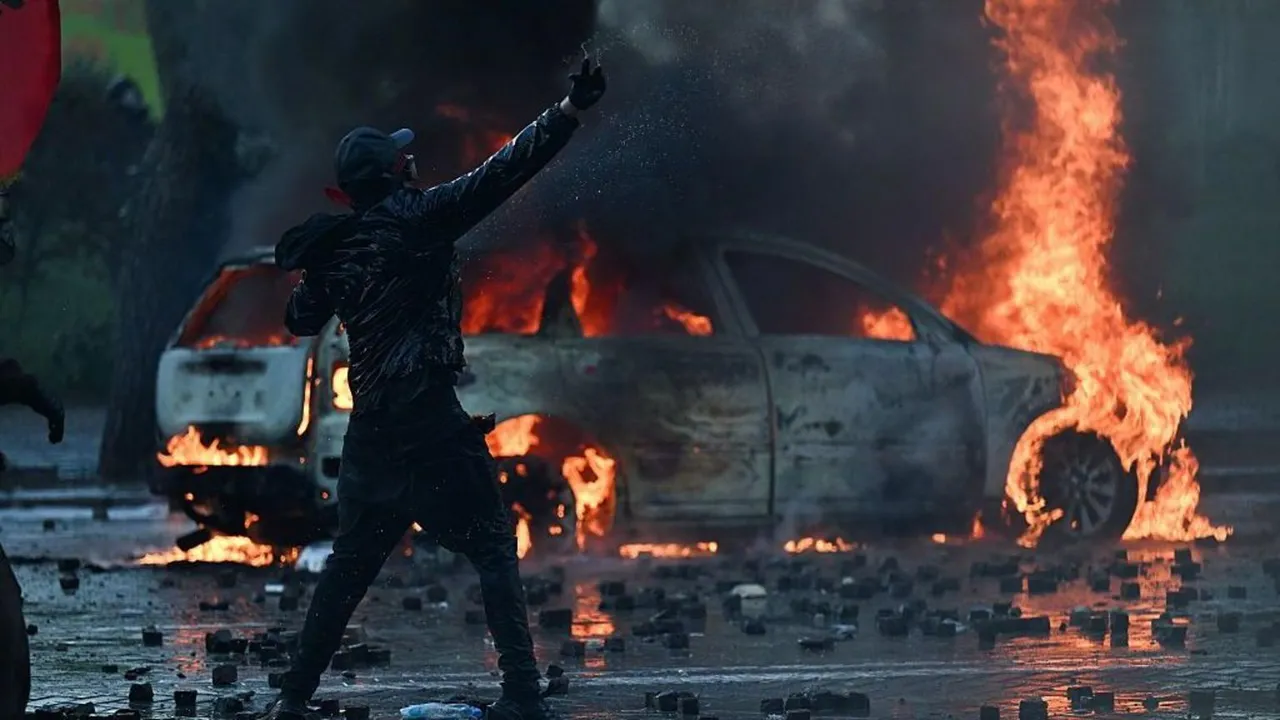
Masked demonstrators, many of them high school and university students, hurled rocks and petrol bombs at riot police defending the education ministry, one of the focal points of the unrest. Police responded with water cannon and volleys of tear gas. Reports indicate rubber bullets were used for the first time during the clashes. Protesters also accused riot police of brutality during the confrontations outside the ministry.
Many in the crowd wore gas masks or face coverings. Volunteers moved through the streets handing out syringes of saline eyewash to ease the pain caused by tear gas. The constant boom of exploding petrol bombs could be heard throughout the afternoon.
As the day progressed, the focus of the protests shifted to the office of Prime Minister Rama on the city's main boulevard, where crowds swelled to larger numbers than on any previous day. Riot police faced a steady hail of cobblestones and fireworks, responding with repeated barrages of tear gas, with some canisters landing deep into the crowds and causing panic. Black smoke from a burning vehicle and the sirens of police cars and ambulances filled the afternoon air. As dusk fell, special forces arrived to reinforce riot police lines.
Many people were injured on both sides. Eighty people have been charged with disorder so far, and hundreds more have been arrested or placed under investigation. The centre of Tirana, scattered with broken glass and burnt debris, increasingly resembles a war zone.
George, a 19-year-old medical student who works as an electrician to fund his studies, stood near the burnt-out education ministry building, a scarf wrapped around his face and goggles covering his eyes. He clutched two rocks in his gloved hands, intended for the police.
Asked whether he was concerned about injuring officers, he said: "We have mothers too. We have family too. We were peaceful for 135 days. Now we are trying to do like in France... we are trying to make a revolution. Our government doesn't want peace, so we are using violence."
Klea, 17, in her first year of university in Tirana, was among the younger demonstrators. "All the students are boycotting their university classes and left school to fight for our rights," she said. She also alleged that provocateurs had infiltrated the protests, smashing shops and banks in an effort to discredit the demonstrations.
The protests, which began in early June, have grown out of corruption allegations linked to Rama's administration and have since broadened into a wider anti-government movement. Demonstrators say they oppose what they describe as "the whole corrupt political class."
Rama, a Socialist Party leader who has been in power for 13 years, has dominated Albanian politics in a manner comparable to his main rival, Sali Berisha of the opposition Democratic Party, who held similar dominance for decades before him.
In a social media post on Saturday morning, Rama urged Albanians to "not forget that we have achieved extraordinary things." He blamed the unrest on the opposition Democratic Party and on what he called "the sinister agenda of foreign actors, intent on halting our progress" toward EU membership, which he has promised by 2030. He did not name which foreign actors he had in mind.
Albania aspires to join the European Union, and Rama has long been viewed favourably by EU institutions. The latest wave of unrest has, however, seriously damaged his standing.
Prominent journalist and self-described activist for change Osman Stafa, of the News24 channel, called for "a neutral, caretaker government for one year, to organise new elections."