KYIV — When Russia launched its full-scale invasion of Ukraine in 2022, Yaroslav Azhnyuk made a decision that would change the course of his career. Like many tech entrepreneurs in the country, he turned to drone warfare.
Azhnyuk, 37, is a computer scientist who spent years working in Silicon Valley. He previously co-founded Petcube, a company that makes smartphone-connected cameras using artificial intelligence to watch and entertain pets.
"These cameras allow pet parents to watch pets when they're not at home," he says, "and fling treats to them and shine a laser toy for them. We sold a million of these devices that are quite popular in the U.S."
After the Russian invasion, Azhnyuk returned his focus to Ukraine and pivoted entirely to defence.
"I was like, OK, I've got to move on from Petcube and do something to protect my country," he says. "And so now we're making not cameras that fling treats but cameras that fling explosives at people who came to occupy our land."
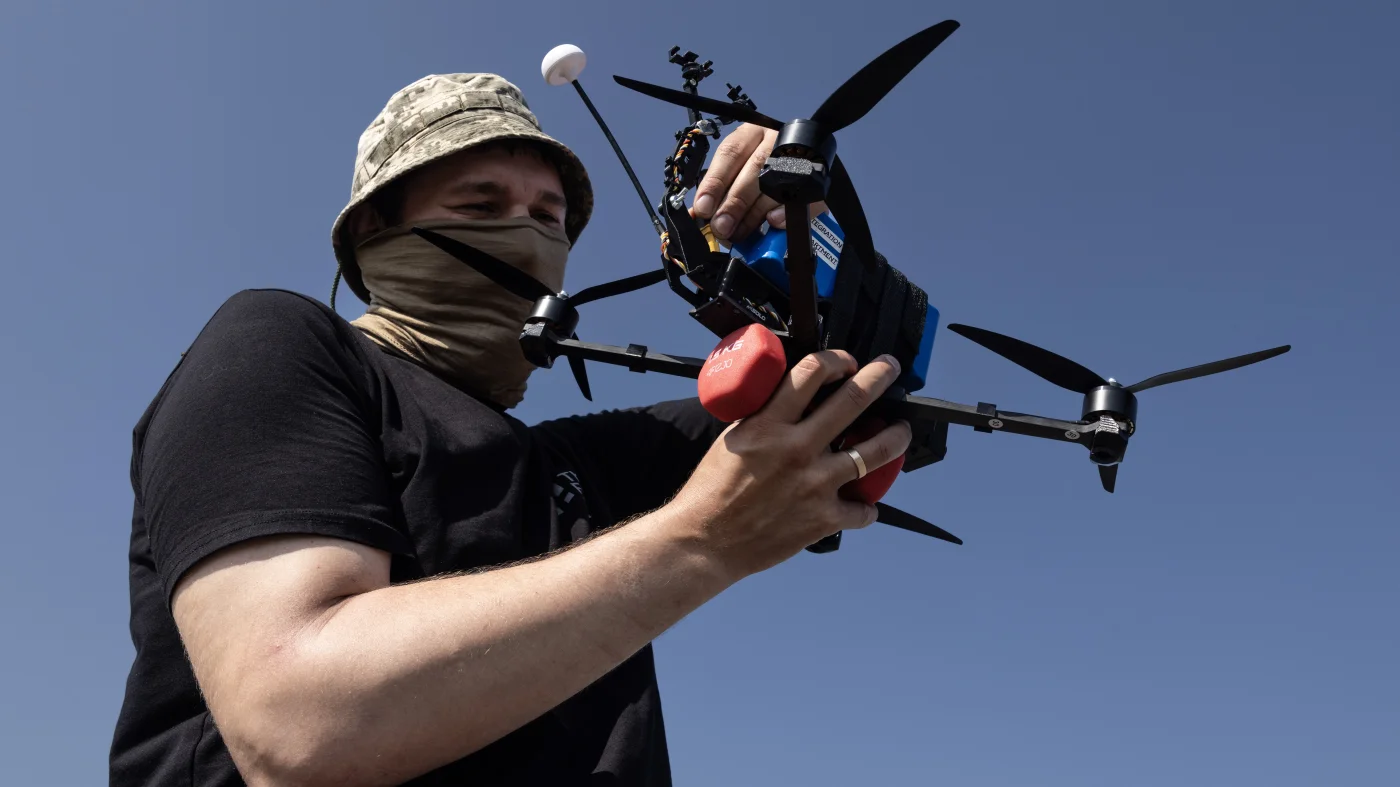
Those cameras form part of an image recognition system built into first-person-view, or FPV, drones — small, fast unmanned aircraft now widely used on the battlefield.
Azhnyuk runs two Ukraine-based defence firms, The Fourth Law and Odd Systems. Together, they are among the leading producers of AI-powered drones in Ukraine. Dozens of Ukrainian military units already use their autonomous drone, the Lupynis-10-TFL-1.
"When the other side has orders of magnitudes higher capabilities, it gives you an asymmetric advantage," Azhnyuk says. "It can make you 10,000 times more effective."
The Lupynis-10-TFL-1 combines a small, affordable FPV drone with an autonomous terminal guidance unit. An onboard computer and AI system take control during the final 500 metres — roughly 0.3 miles — of the drone's flight.
Azhnyuk is careful to distinguish this technology from more familiar forms of artificial intelligence.
"But it's very different from, say, the kind of AI that sits on those data centers that power Claude," he says. "Or even the kind of AI that does self-driving for your Tesla."
He describes it as a simpler system designed to recognise images and make targeted decisions — allowing the drone "either to navigate autonomously without a human or to choose a target autonomously or to fly toward the target autonomously."
The drone is named after Anatoliy Lupynis, a 20th-century Ukrainian poet and political activist who endured decades of Soviet imprisonment and psychiatric torture. The Fourth Law has named all of its weapons after Ukrainian intellectuals and artists killed or persecuted by Russians in the previous century.
"It is important for us to help to resurrect those people," Azhnyuk says. "Their ideas are still with us. And now they're fighting back."
Ukraine is not alone in deploying AI-enabled drones. Russia is also using the technology against Ukrainian forces, making autonomous aerial weapons a defining feature of the conflict on both sides.
The rapid development of AI warfare has alarmed observers well beyond the battlefield. Ukrainian President Volodymyr Zelenskyy has warned that artificial intelligence could begin leading decisions on the battlefield as soon as next year.
Azhnyuk acknowledges the concern but argues it is not unique to AI.
"It has been with humanity since the invention of fire or steel," he says. "Any kind of tool can be used for good or for bad. And in the end, it's the human that decides how to use that tool."
Testing of the Lupynis TFL-1 takes place daily. One team operates from an overgrown field outside Kyiv, working at a fold-out table near a cluster of trees. The head of the test and integration team, who uses the military call sign Stab, oversees the process. The Fourth Law asked that the location and the identities of those working there not be disclosed for security reasons.
"We are leaders in autonomous drones and thermal cameras," Azhnyuk says.
The conflict in Ukraine has become a proving ground for a new generation of AI-driven weapons, accelerating an arms race that experts and world leaders warn could fundamentally alter how wars are fought.