Serbia's long-ruling leader Aleksandar Vucic has conceded defeat after a student-led protest movement won a sweeping victory in snap parliamentary elections, triggering mass celebrations across the country.
With nearly 97 percent of polling stations counted, the Student List secured approximately 52.7 percent of the vote, while Vucic's Serbian Progressive Party (SNS) received 39.2 percent. Projections suggested the Student List would win around 140 seats in the 250-member parliament, well above the 126 needed for a majority, with Vucic's bloc taking 103 seats. No other party crossed the 3 percent threshold, with national minority parties taking the remaining seven seats.
"It is clear we have lost these elections," Vucic said, speaking at SNS headquarters in Belgrade.
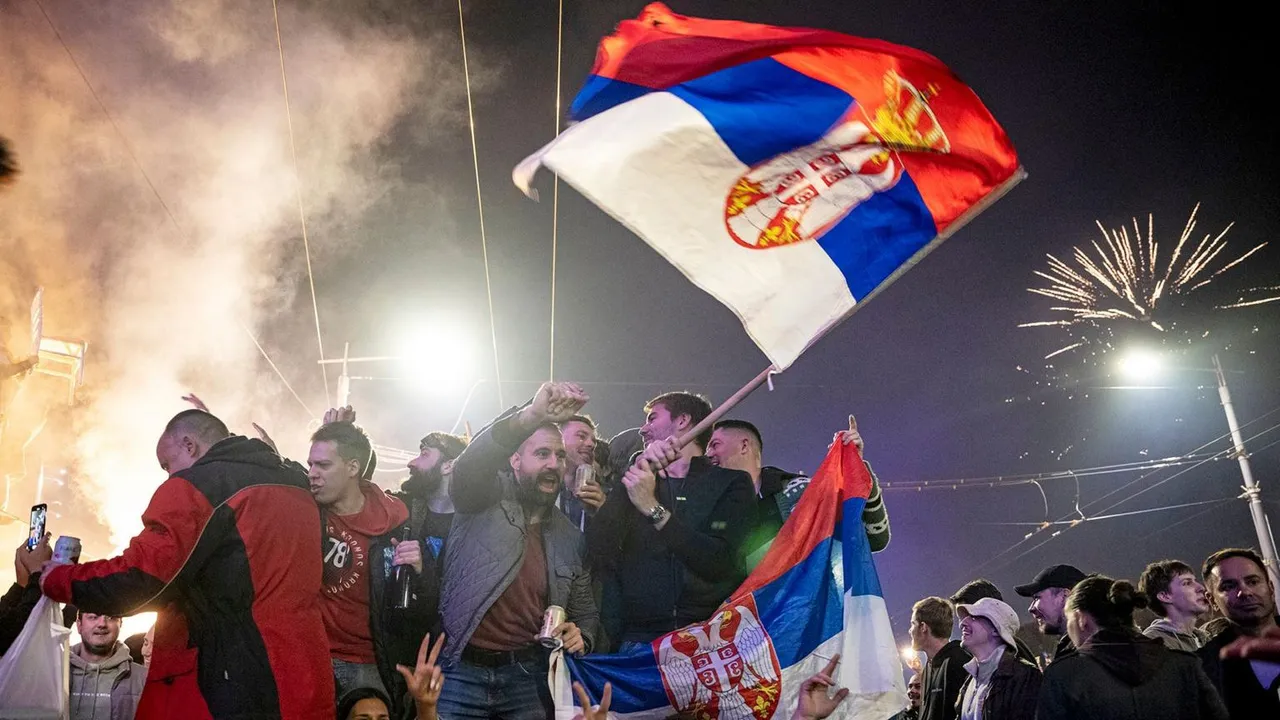
Crowds gathered in the centres of Belgrade, Novi Sad and other cities as results came in. People danced and chanted "victory," cars honked, and fireworks were set off.
"Serbia is free," one student told reporters. "It's a miracle."
"We are all crying, and what to say. We couldn't believe that it would be so easy," said Selena Lebovic, celebrating in Belgrade.
The Student List's lead candidate, Ilija Srdanovic, said the movement hoped to "free the country from tyranny." "This will be a free state," he said.
During a celebration speech, Student List candidate Radomir Saicic said Serbians had shown "no obstacle was greater than their will." "No force can forever overpower a people who have decided to take their destiny into their own hands," he added.
The student movement emerged less than two years ago following the collapse of a canopy at Novi Sad railway station, which killed 16 people. The disaster was widely blamed on corruption and negligence, and triggered sustained protests that eventually led Vucic to call snap elections.
The Student List fielded candidates from across Serbian society, including doctors, actors, academics and sports personalities. The movement campaigned on a manifesto that included removing officials who cracked down on protesters, ending the appointment of party loyalists to lead public enterprises, and freeing the public broadcaster from political control.
Vucic and the SNS have repeatedly denied corruption.
"This is not an ordinary election victory, this is an avalanche that has wiped out an authoritarian regime and entire political scene," said Nebojsa Vladisavljevic, professor of political science at the University of Belgrade. He said the Student List had "absolute legitimacy" to govern in the coming years.
Vucic had served two terms as president and was ineligible for a third. He had been leading the SNS with the aim of returning to the post of prime minister, a position he left in 2017.
International observers presented their preliminary findings on the vote, raising a number of concerns about the conduct of the election. Special coordinator Gilles Baum said the election "unfolded in the atmosphere of profound polarisation, with the equality of campaign opportunity seriously compromised" through "entrenched advantages enjoyed by the ruling party." He also cited suspected misuse of state resources, as well as intimidation and pressure on voters and candidates.
Ireland's Eoghan Murphy, who headed the ODIHR observation mission, highlighted serious issues with media coverage, saying state broadcasters showed "pronounced imbalances in exposure and treatment of contestants, contrary to its legal obligations and public service mandate." He also warned that online campaigning "remains largely unregulated," with "no dedicated oversight mechanism, safeguards or accountability."
Concerns were also raised about voting arrangements for the Serbian diaspora, with observers noting that voters in some countries faced long queues and inadequate access to polling stations.
Kremlin spokesperson Dmitry Peskov praised Vucic's contribution to relations with Russia and expressed hope that "the new political force" in Belgrade would understand that cooperation with Moscow was in Serbia's interests, adding: "But, as you know, it takes two to tango."
The result was welcomed by Hungarian opposition leader Peter Magyar, who said he was delighted to hear from the Student List's leaders about the movement's achievement.
Vucic had backed Serbia's candidacy for European Union membership while refusing to impose sanctions on Russia over its full-scale invasion of Ukraine. The election outcome has raised hopes for a new opening in Serbia's relations with the EU and other international partners.