The United States military and US defence corporations control or have access to more than 110 defence facilities on Australian soil, accounting for well over half of all military installations in the country, according to new data compiled by the Nautilus Institute.
The database, published by Guardian Australia, maps the full extent of US military presence across the continent. Researchers describe the situation as a "saturation" of Australian territory.
Of the 110 facilities, the US military directly controls 17 on mainland Australia and has access to a further 75 Australian-run installations. US defence corporations have access to an additional 18 facilities.
"We have been thinking about American influence on Australian defence policy as a matter of penetration," said Prof Richard Tanter, the database's author. "And we're aware of the closeness of the alliance, the integration of the armed forces."
"But what this database shows is it's not a matter of penetration, it's a matter of saturation. Over half of the defence facilities that we have looked at have some level of American access: that means American personnel, it means American corporations, some of the biggest armaments companies in the world."
The US military uses its access to Australian facilities for a range of purposes. These include gathering intelligence, accessing satellite data for targeting and communications intercepts, training exercises, pre-positioning warfighting assets, and maintaining logistics hubs stocked with weapons, munitions and fuel in preparation for a potential conflict in the Pacific.
Approximately 2,500 US marines rotate through the Northern Territory on a dry-season basis. The Bradshaw field training area, also in the Northern Territory, covers an area the size of Cyprus but remains largely unknown to the public.
The Bandiana base in Wodonga, announced in June, will host tens of millions of dollars worth of pre-positioned US weapons, munitions, fuel and vehicles, ready for rapid deployment in the event of conflict in the Pacific.
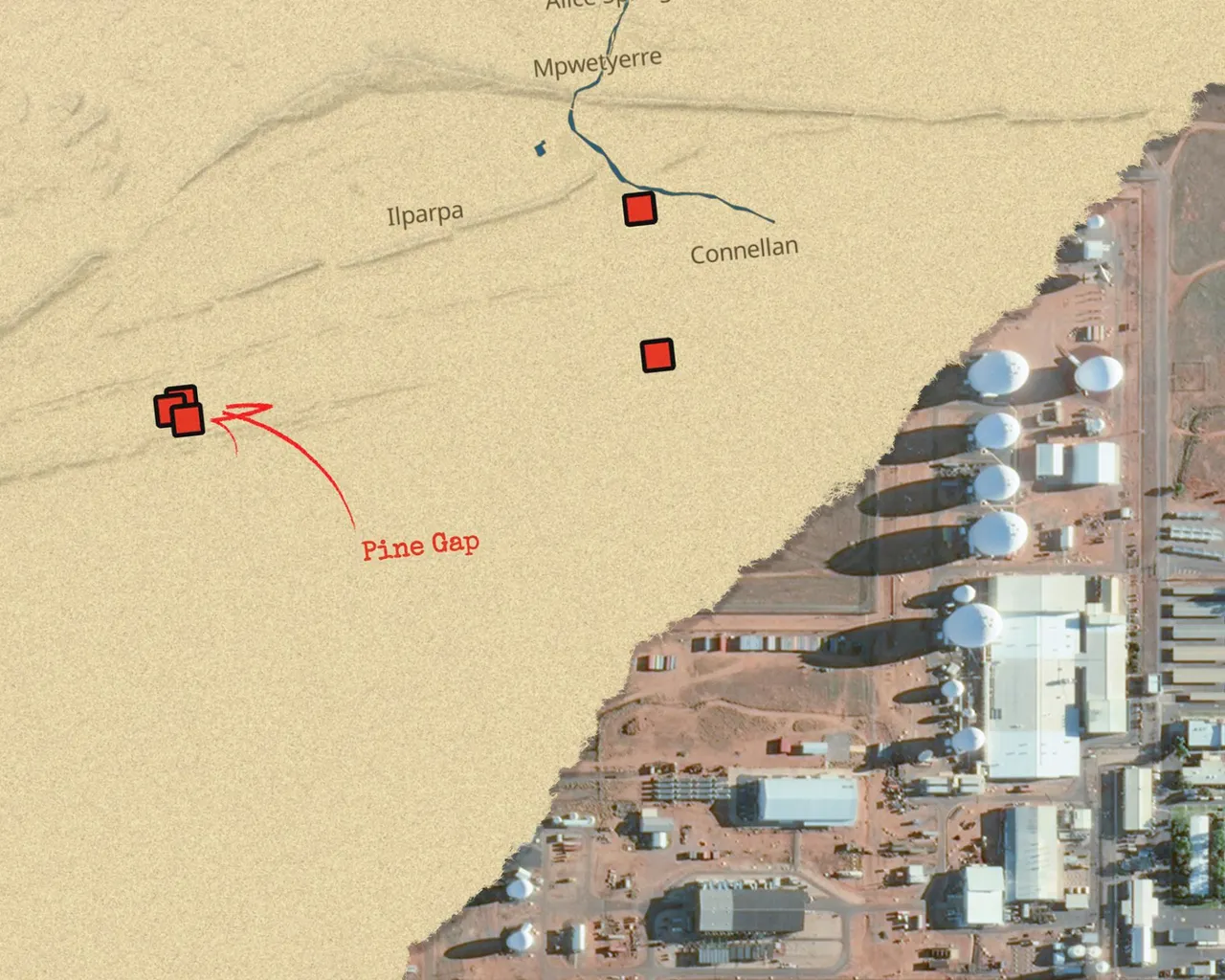
Pine Gap, near Alice Springs, is among the best-known US-controlled facilities in Australia. It hosts multiple distinct defence functions, including a ground-control station for signals intelligence satellites, a relay station for early-warning missile launch systems, and a site for intercepting foreign satellite communications. The Nautilus Institute counts each function as a separate facility, meaning Pine Gap alone accounts for three entries in the database.
Despite its prominence, Pine Gap's precise role in US warfighting operations remains classified and largely hidden from public view.
Beyond direct military access, at least 42 Australian military facilities are used by US defence contractors for manufacturing, testing and training related to weapons systems deployed by militaries around the world.
Lockheed Martin assembles guided missiles at Port Wakefield in South Australia. Northrop Grumman signed a multimillion-dollar contract this year to build rocket motors for guided weapons at Mulwala in New South Wales.
The Australian Defence Force has said that collaboration with US manufacturers will "promote allied interoperability and provide a second source of supply for critical munitions."