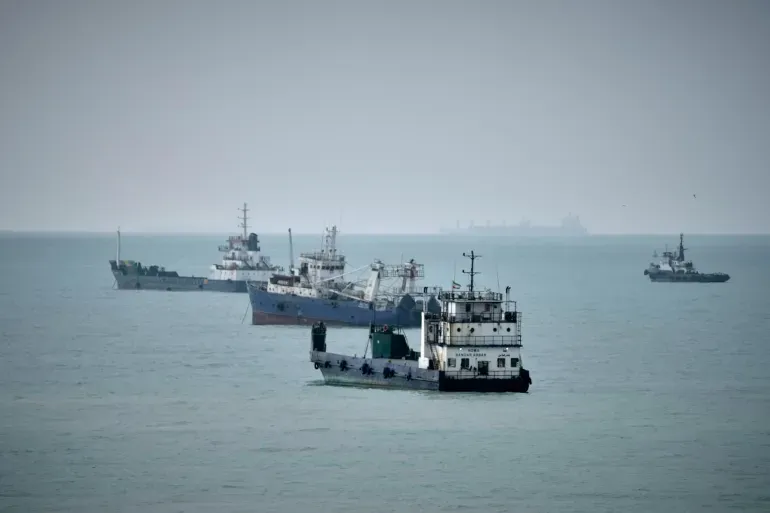
South Korea is reviewing possible military contributions to secure freedom of navigation in the Strait of Hormuz, the presidential office said, as Washington increases pressure on Seoul over its reluctance to support the US war against Iran.
The presidential office issued a statement on Friday saying various options for providing assistance in the strategic waterway were being considered. It stressed, however, that no decision had been made.
"Our government has been closely discussing with the international community ways to make practical contributions for the speedy restoration of free navigation in the strait of Hormuz and peace and stability in the Middle East," an unnamed official said.
South Korean domestic media reported on Thursday and Friday that preparations were already under way and that the government intended to seek parliamentary approval for a new deployment. The reports said the exact scale and timing had not been agreed.
The presidential office pushed back against those reports, saying they were "different from the facts" and that "nothing related to the matter has been decided", though it confirmed the review was continuing.
Assets reportedly under consideration include a P-8 Poseidon maritime patrol aircraft, which would mark South Korea's first overseas deployment of such an aircraft, and a naval logistics support ship. One outlet additionally reported that an explosive ordnance disposal team from the navy's underwater demolition unit was part of the package.
An official said South Korea "may be able to make military contributions to global efforts to ensure free navigation through the strait, as long as such contributions do not compromise its military readiness." He added that the discussion had "not reached the stage of seeking parliamentary approval."
Any new military deployment would require a review by the National Security Council, a cabinet resolution, and approval from the National Assembly. South Korea's defence minister told parliament in March that any deployment to the strait would require the assembly's consent, given how different such a mission would be from the existing anti-piracy mandate.
South Korea is heavily dependent on the Strait of Hormuz. The country relied on supplies transiting the waterway for 61 percent of its crude oil imports and 54 percent of its naphtha imports last year, according to one set of figures. A separate report put South Korea's overall primary energy imports through the strait at more than 90 percent, with roughly 70 percent of crude oil passing through the waterway.
The United States has been pressing Seoul and other allies over their refusal to join its military campaign against Iran, which has seen Tehran limiting maritime traffic through the strait, a key route for global oil supplies.
President Donald Trump said in August that he had cancelled, or scaled back, US-South Korea joint military exercises in part because Seoul had declined to help in the war against Iran. Trump publicly claimed that South Korean President Lee Jae-myung had told him "No, thanks" despite the US stationing tens of thousands of troops on the peninsula. Days later, Trump ordered the Ulchi Freedom Shield joint military exercises to be shortened by six days.
Following that episode, the South Korean government said it would pursue a deployment to the strait only after the US-Iran war ends.
Relations between the two allies have also been strained by delays in implementing a $350 billion investment package Seoul agreed with Washington, reports of US restrictions on intelligence sharing with South Korea, and a dispute over a data breach at South Korean e-commerce company Coupang.
President Lee may discuss options regarding the Strait of Hormuz when he meets French President Emmanuel Macron next week, the presidential office official said.
Public support for military involvement in the Middle East appears limited. A Gallup Korea poll from March found 55 percent of respondents opposed sending South Korean warships to the strait.
The presidential office insisted that claims South Korea had provided no assistance related to the Strait of Hormuz were "not true", noting that Seoul had long discussed practical contributions with the international community. In late 2019, South Korea's military expanded the deployment of its anti-piracy unit from Somalia to the area around the strait after the US pressed for help guarding oil tankers.