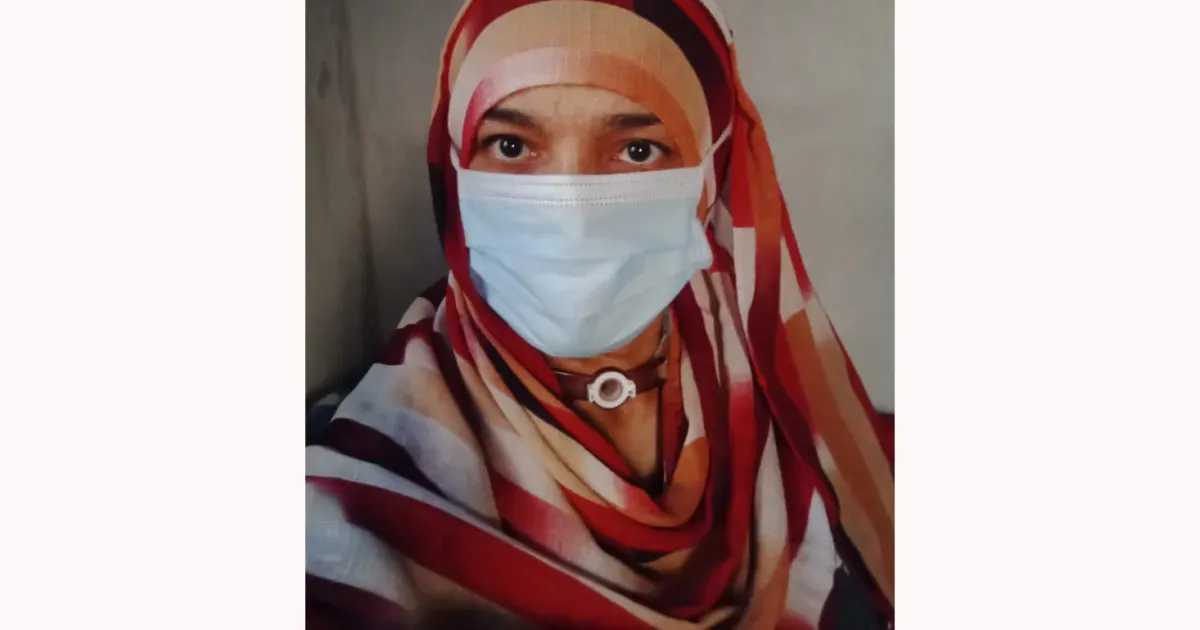
Rajaa Ghirsan, a 50-year-old seamstress from Sanaa, can barely speak or breathe. Vocal cord paralysis and severe complications in her larynx have left her dependent on a device fitted around her neck to keep air flowing and prevent suffocation. The device must be replaced every two months at a cost of $100 each time.
She has undergone six operations in Egypt and India since 2006 in an attempt to restore normal breathing, but now requires another complex procedure abroad to open her airway. Yemen's conflict-weakened health system lacks the infrastructure and specialist care she needs.
After registering with the Higher Medical Committee in Sanaa, the body responsible for arranging medical treatment abroad, Ghirsan spent seven years trying to secure a seat on a once-weekly flight to Amman, where Yemeni patients have been treated. Repeated closures and air attacks have kept that flight out of reach. She cannot afford the long overland journey to Aden airport, her only alternative out of the country.
"The device helps her breathe a little, but it has worn her out and taken away her rest for years," said Nouran al-Salawi, 28, Ghirsan's daughter, who has cared for her mother for the past decade while raising two children of her own. "She is waiting for the moment she can have the last operation and be free of it, or she is waiting for death instead."
Ghirsan is among many Yemenis who depend on Sanaa International Airport to access medical care abroad. The airport is the main air link for millions living under Houthi control in the north, but it has been repeatedly shut since the Saudi-led coalition closed it to commercial traffic in August 2016.
A United Nations-brokered truce allowed a limited number of flights to resume in May 2022. However, air attacks in 2025 damaged the airport and destroyed aircraft. In July, Yemeni government forces backed by Saudi Arabia struck its only working runway to prevent an Iranian plane carrying a Houthi delegation from landing. As of now, no regular flights depart from the capital.
Aden, the seat of the internationally recognised government and the main alternative for patients in the north, has also come under attack. The airport there was struck twice this month, most recently on October 16, when two missiles landed approximately 500 metres from a Yemenia aircraft preparing to take off for Cairo.
With Sanaa airport out of operation, Aden under attack, and unrest this year in Seiyun, a city in the eastern province of Hadramout that hosts another airport, patients in northern Yemen have few remaining options.
Mohammed Shajara, 30, attempted to reach Tehran in June for treatment for his paraplegic five-year-old daughter. He was stranded in Tehran when the government blocked Iranian flights to and from Sanaa in July, and the family returned without receiving treatment. Aden was his next option, but the journey remained out of reach.
Anis al-Asbahi, spokesperson for the Houthi-run Ministry of Health in Sanaa, said repeated closures of Sanaa airport over the past decade have affected approximately 400,000 patients, including 250,000 who require treatment abroad.
The disruptions have also affected more than 125,000 people with cancer who face medicine shortages. "It has led to shortages of more than 1,600 types of medicine, including 12 cancer drugs that are barred from entering the country," al-Asbahi said. "Additionally, more than 40,000 patients with thalassemia and haemolytic anaemia face shortages of iron chelation drugs and the intravenous solutions needed for their treatment."
Fighting between government and Houthi forces has reignited in recent months, leading to new restrictions on the movement of aid and people. This month, UN envoy Hans Grundberg told the Security Council that Yemen had slid back into full-scale war.