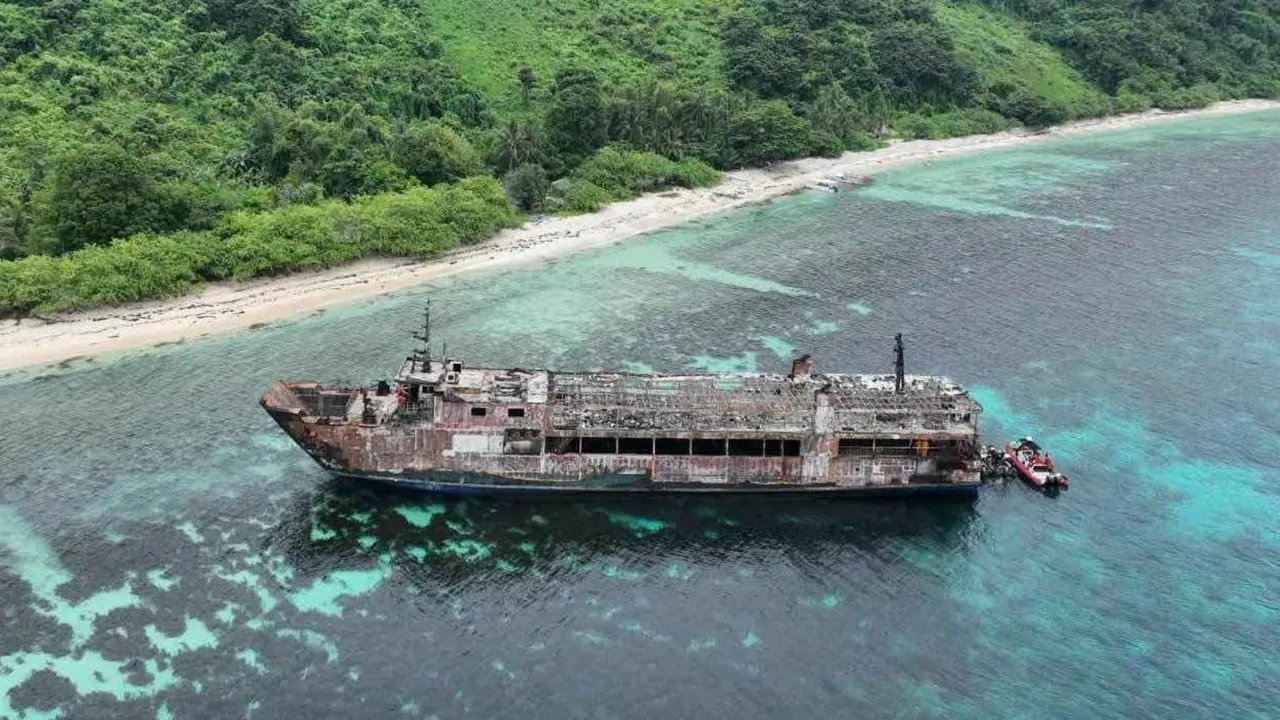
The death toll from a ferry fire in the Philippines has risen to 35, with authorities warning the number will climb further as recovery operations continue aboard the stricken vessel.
The MV June Aster, carrying 132 people on board, caught fire on Wednesday evening as it neared the tourist destination of Coron in the western province of Palawan, after departing from Manila on a 22-hour journey. The vessel's manifest listed 134 crew and passengers, but two had not boarded.
The fire broke out in the cargo hold and spread through the ship within seconds, according to the coast guard. Survivors reported hearing a loud explosion before smoke and flames engulfed the vessel. Strong winds are believed to have accelerated the spread of the blaze.
Coast guard spokesperson Commodore Noemie Cayabyab said those who survived had barely enough time to react. "From the time that they heard the loud explosion, the appearance of smoke, and then fire. It spread very quickly," she said, citing survivor accounts. "Everything happened in seconds," she added, noting that many passengers had not had time to put on life jackets.
Forty-three people were rescued, with many receiving treatment in hospital. Figures on those still unaccounted for varied across reports, with sources citing between 54 and 84 missing, the higher figure later revised downward after two people on the manifest were confirmed not to have boarded.
Thirty bodies were recovered from the vessel and transported to a port near Coron on Saturday morning. Five others had been confirmed dead in the immediate aftermath of the fire, bringing the total to 35. Cayabyab confirmed the remains were found in the ship's economy accommodation area.
Authorities were unable to board the vessel until Friday due to toxic fumes and lingering heat. Rows of body bags were transported by patrol vessel, with personnel in hazmat suits carrying out the recovery. Cayabyab said the first transfer was limited to 30 bodies due to the capacity of the patrol vessel, and that additional remains were still aboard the ferry.
"Agencies are currently undertaking the proper recovery and identification of the remains in accordance with established procedures," Cayabyab said at a Saturday press conference. "We recognise the grief of the families affected by this tragic incident."
The bodies were turned over to police forensic investigators for identification before local authorities notify family members. "Currently, we are focused on the retrieval, and after that we will proceed with the investigation," Cayabyab said.
A survivor told sources he had heard frantic cries on board when the fire erupted and was trampled by panicked passengers as he tried to escape. Some passengers jumped into the sea and were rescued by nearby fishermen. The vessel ran aground approximately seven kilometres off the village of Turda.
Among those waiting for news was Myra Cabilan, who flew to Coron to search for her missing brother, 40-year-old Rammel Gonzaga, who had taken the ferry from Manila on a business trip. "His wife had just given birth a month ago. He was so happy he was given a daughter," Cabilan said. "At dawn, I still believed he survived. But he's still missing. I have lost hope."
The ferry was built in 2002, held valid safety certificates, and passed an enforcement inspection in March. Investigators are examining potential manifest discrepancies, cargo loading integrity, and crew emergency response protocols. The vessel was carrying goods, an electric vehicle, a pickup truck, motorcycles, and heavy-duty equipment.
The Philippines' maritime authority is leading the investigation. The coast guard, army rescue boats, divers, fishermen, and private resort owners have all assisted in search operations.
Atienza Interisland Ferries, the vessel's operator, said it was fully cooperating with the inquiry. "Our hearts remain with the affected families, and we will not rest until all individuals are accounted for," the company said in a statement.
The Philippines has a long history of maritime disasters. Ferries are among the most widely used forms of transport across the archipelago's more than 7,000 islands, and accidents have frequently been linked to overcrowding, adverse weather conditions, and lax safety standards.