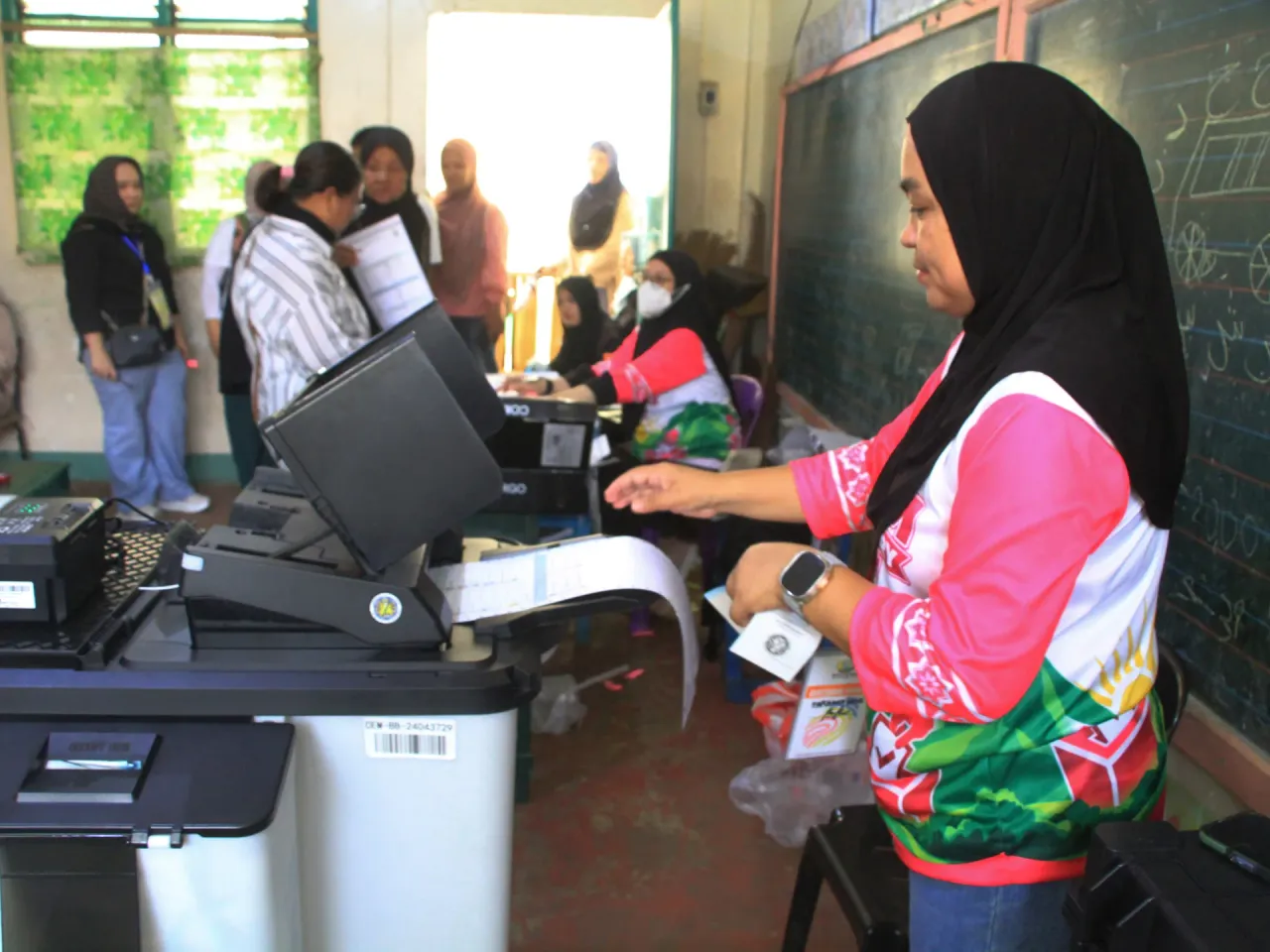
The first parliamentary election in the Bangsamoro Autonomous Region in Muslim Mindanao (BARMM) in the southern Philippines has ended in a hung parliament, with no single party securing a majority, according to unofficial results.
With more than 99 percent of votes counted as of Tuesday evening, the two rival parties that emerged from the separatist Moro Islamic Liberation Front each held more than 30 percent of the vote, according to a partial count. Neither secured the 41 seats needed for a majority in the 80-member parliament.
The Moro Islamic Liberation Front signed a peace agreement with the Philippine government in 2014 after decades of conflict over independence and self-governance. It served as an interim government after voters approved the autonomous region in 2019.
Last year, Philippine President Ferdinand Marcos Jr. replaced longtime front chairman Al Haj Murad Ebrahim with Abdulraof Macacua, a former front commander, as chief minister. The move deepened internal divisions in the Muslim-majority region.
Macacua, who leads the Bangsamoro Federalist Party, acknowledged that forming a coalition with other parties is "an unavoidable situation" following Monday's vote.
Ebrahim told reporters after casting his ballot that he hoped his party, the United Bangsamoro Justice Party (UBJP), would clinch most of the seats, but expressed openness to negotiating with other parties. "If the party does not get majority of the seats, we will look for parties who can be our allies so that we can form a coalition," he said.
Some voters had feared a return to fighting if the UBJP failed to secure a commanding lead, particularly because the front has halted the disarming of former fighters, citing the government's failure to deliver promised aid.
"One of the commanders of the Moro Islamic Liberation Front has said that if they don't win the election, there might be war again," voter Alinair Aracaya said.
The commander he referred to was Abdullah Macapaar, also known as Commander Bravo, a 64-year-old described as one of the most defiant front leaders. On Monday, Macapaar, who was also running for a parliamentary seat, voted for the first time in his life.
Authorities said the elections were generally peaceful, but security forces remained on high alert. Multiple shooting incidents on election day left at least three people dead and several wounded.
"We will still hold our deployment in place even after the proclamation of winners. We are trying to ensure that the security situation will remain stable," said Brigadier General Jemuel Siason, deputy police director of the Bangsamoro region.
Miriam Coronel-Ferrer, who led peace negotiations with the front on behalf of the government, commended the participating parties in a social media post "for their great effort to build their capacity to enter the field of electoral politics and play by the rules of the electoral process."
For many residents, the election carried deep personal significance shaped by years of conflict. Voter Norhailyn Madayan recalled a childhood spent fleeing violence. "Just the sight of soldiers terrified us because that meant there might be clashes again. There were also clan wars," she said.
Madayan and her husband Aracaya said peace has allowed them to build a life, including a thriving business and a newly constructed home. But they also acknowledged that peace has remained fragile.
In 2016, fighters linked to the Islamic State briefly seized control of their town. The following year, the same group laid siege to Marawi City, prompting a military response that included air strikes.
Asraf Balt, a resident who was nine years old at the time of the Marawi siege, said he did not immediately grasp the gravity of the situation until he saw the damage to his family's home. "We got displaced, and our house got destroyed. Like, heavily destroyed to the point that we had to rebuild it," he said. His family has since returned, but hundreds of other residents remain in temporary shelters.
Analyn Pangandaman said her family cannot afford to rebuild their home without government reparations. She has been waiting for compensation for nearly nine years.