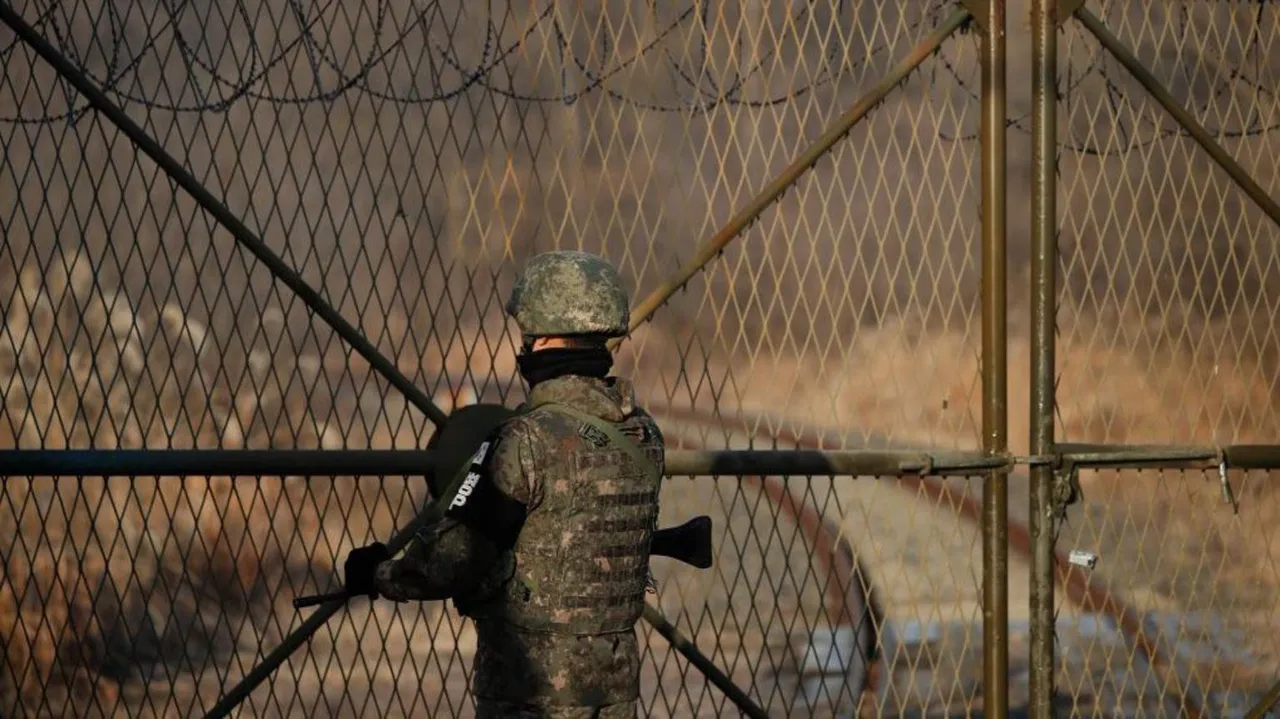
Three South Korean soldiers were injured by landmine explosions inside the Demilitarised Zone (DMZ) on 21 September, triggering a sharp exchange of accusations between Seoul and Pyongyang.
The three men were part of an 18-strong patrol clearing a new route through the DMZ as part of an investigation into North Korean troop activity in the western sector of the zone. Shortly before 11 a.m., the patrol was approximately 10 metres south of the Military Demarcation Line (MDL) when a staff sergeant detonated a mine. A second mine exploded as the unit commander approached to assist. Both men were evacuated and underwent surgery; a third soldier was treated for minor wounds.
South Korea's military, following a joint investigation with the United Nations Command, concluded that the mines were of North Korean origin. The Joint Chiefs of Staff formally accused Pyongyang of sowing mines south of the MDL, calling it a breach of the 1953 armistice agreement.
South Korean Defence Minister Kang Shin-chul described the blasts as a "clear" violation of the armistice. Kang Hyun-woo, chief director of operations, went further in a press briefing on Wednesday.
"This constitutes a blatant violation of the Armistice Agreement and undermines the spirit of existing inter-Korean agreements and must be halted immediately," he said. "North Korea must immediately cease activities that heighten tensions on the Korean Peninsula, such as its so-called 'border fortification.' We strongly demand an apology and responsible measures from the North."
South Korea said it was "certain" the blasts originated from North Korean mines laid to fortify Pyongyang's side of the border, and vowed to take "corresponding measures."
North Korea denied all responsibility. Kim Yo Jong, the sister of North Korean leader Kim Jong Un, dismissed Seoul's claims as "groundless" and a "farce" designed to escalate tensions on the peninsula. She accused South Korea of "cooking up" the allegations for "political and military provocation" and denied that North Korean personnel had crossed the border to plant the mines, calling the assertion "a deliberate and planned strained assertion to shift the responsibility for escalating tension" to the North.
Her statement, published in state media on Wednesday, warned the South to be "prepared for paying price for the farce of their own making."
Kim also referenced a 2015 incident in which two South Korean soldiers were maimed by landmines in the DMZ. South Korea had blamed North Korea at the time, a claim Pyongyang denied. Kim alleged that Seoul had used that episode as a "pretext" to escalate tensions and was doing the same now.
The United Nations Command confirmed its findings in a statement. "UNC has determined that an Armistice Agreement violation occurred. UNC is addressing the violation through established Armistice mechanisms," it said, adding that it remained "committed to maintaining and enforcing the Armistice Agreement and fulfilling its responsibilities to preserve stability and prevent escalation on the Korean Peninsula."
The 4-kilometre-wide DMZ has divided the peninsula since the Korean War ended in an armistice in 1953. The strip contains the MDL, which marks the land border between the two Koreas, and has been the site of sporadic clashes and mine explosions over the decades.
A professor of foreign policy at South Korea's Kyung Hee University linked the latest incident to a broader strategic shift by Pyongyang. "The North revised its constitution in March this year and officially stated that they intend to define the absolute geographical limits of the nation, and that includes within the DMZ," he said. "They want to maximize their territory and it is my sense that they would like to push the Military Demarcation Line further south. I see the placing of landmines on the South's side of the line as a purely political act by the North, an attempt to threaten and intimidate the South."
Reports also indicate that North Korean troops crossed the MDL approximately 20 times in August and around 30 times in September. South Korean troops fired warning shots on each occasion.
Analysts warn that the deterioration in inter-Korean relations since 2015 has significantly raised the risk of accidental escalation. A senior consultant with the Crisis Group noted that the two Koreas no longer maintain the low-level communication channels that existed a decade ago. "Accidental escalation on the Korean Peninsula is always just a few steps away, and it's fewer steps now than it was in 2015," he said.
Within South Korea, some politicians have called for stronger action. A member of the conservative People Power Party demanded that the military conduct exercises simulating a strike against the North Korean leadership, called for the resumption of loudspeaker propaganda broadcasts along the border, and urged that dissident groups be permitted to launch balloons carrying propaganda into the North.