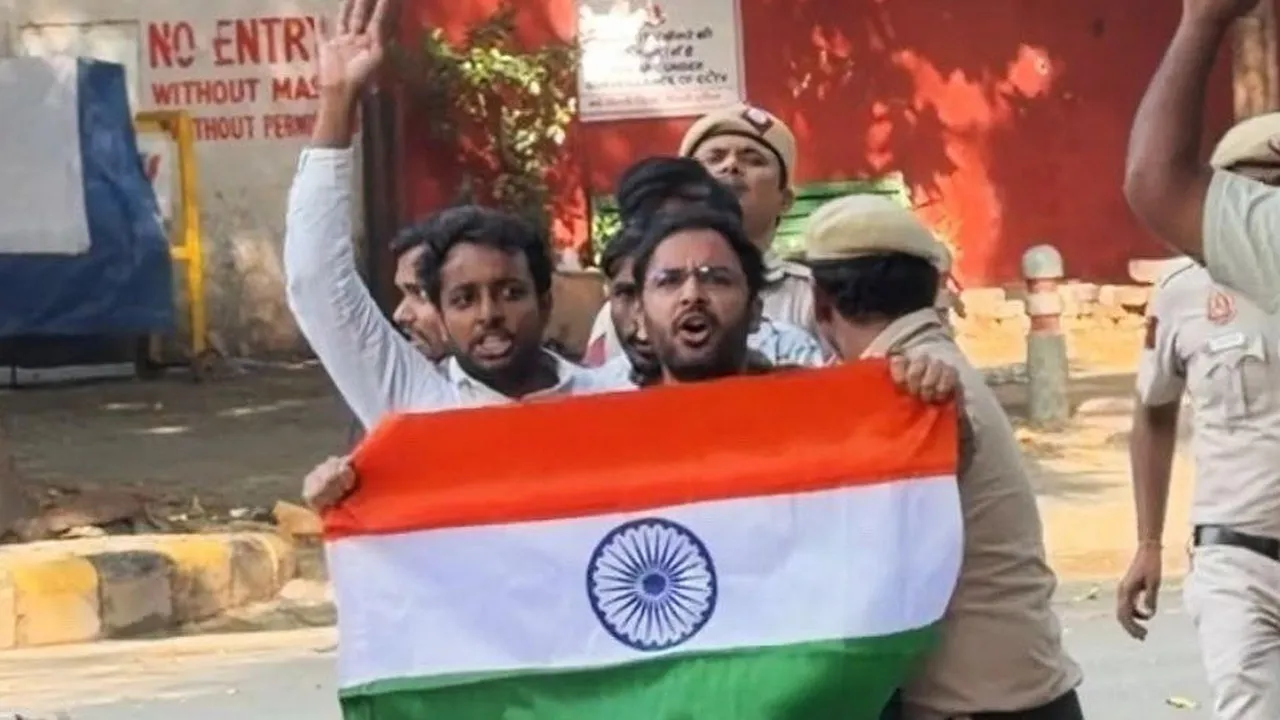
Leaders of India's youth-led Cockroach Janta Party (CJP) were detained on Tuesday after they jumped barricades to enter Jantar Mantar, a historic New Delhi observatory long associated with public protests, which authorities had recently declared off-limits.
CJP leaders Ashutosh Ranka and Saurav Das, along with other volunteers, were among those taken into custody. A third leader, Ajinkya Shinde, was also reported to be among the approximately 20 volunteers who entered the site. The group chanted slogans and waved the Indian flag as police arrived and detained them.
Party founder Abhijeet Dipke shared videos of the incident on social media. "You cannot denotify the resistance," he wrote on X. Das also posted a message declaring the site had been "reclaimed" before announcing their detention.
Ranka later appeared in an Instagram live broadcast from a police bus alongside other detainees. The group appeared cheerful and said they would not back down.
It was not immediately clear where police had taken the detainees.
The detentions came a day after the federal home ministry announced that Jantar Mantar would no longer serve as a designated protest venue. Authorities identified three alternative locations where demonstrations can be held with permission.
Ranka had earlier noted the timing of the decision on X. "30 mins after we went to Delhi Police asking for a date when we can go to Jantar Mantar, Jantar Mantar was de-notified as a protest site," he wrote.
Before the announcement, the CJP had met Delhi Police officials to seek permission for a peaceful protest at the site and had warned it would announce further demonstrations if it received no response.
The protests centre on demands for the resignation of Chief Election Commissioner Gyanesh Kumar over a controversial revision of electoral rolls. Critics, including opposition parties, allege the exercise favours Prime Minister Narendra Modi's Bharatiya Janata Party. The Election Commission has denied favouring any party and said wrongly deleted voters can re-enrol. Modi's party has also rejected the allegations.
Anger over the revision intensified after reports emerged that Kumar had disregarded concerns raised by the two other election commissioners over changes to voter registration. The Election Commission has said its decisions were unanimous.
On Monday, the Congress party, India's main opposition, petitioned the Supreme Court challenging the Election Commission's voter revision exercise, which has resulted in tens of millions of names being removed from electoral rolls. Separately, opposition parties held a march in Delhi from Connaught Place to the Supreme Court.
The weekend before Tuesday's detentions saw a major security clampdown across the capital. Several metro stations were closed, train services were disrupted, and thousands of police and paramilitary personnel were deployed. Police detained and released thousands of people over the weekend, including several journalists. Videos and photographs from the protests showed police dragging people, including women, by force and pushing them into buses.
Dipke himself had been among CJP leaders detained ahead of a planned demonstration on Saturday and was released the following day. He had travelled to his hometown in Maharashtra after the death of his grandmother.
"If Modi thinks taking away Jantar Mantar will put an end to protests, he is mistaken. Jantar Mantar is not just a location but a spirit of resistance that nobody can ever take away," Dipke said in an earlier statement.
The CJP originated as online satire after India's Chief Justice Surya Kant compared some unemployed young people to cockroaches during a court hearing in May. He later said his remarks had been misinterpreted, but the comments became a rallying cry for young people seeking change.
The movement evolved into a pressure group, channelling wider anger over unemployment, exam irregularities and government accountability. Earlier this year, CJP-led protests over exam irregularities and demands for education reform culminated in the resignation of federal Education Minister Dharmendra Pradhan.
The youth-led movement is considered one of the most significant political challenges to Modi and his party in his 12 years in power.