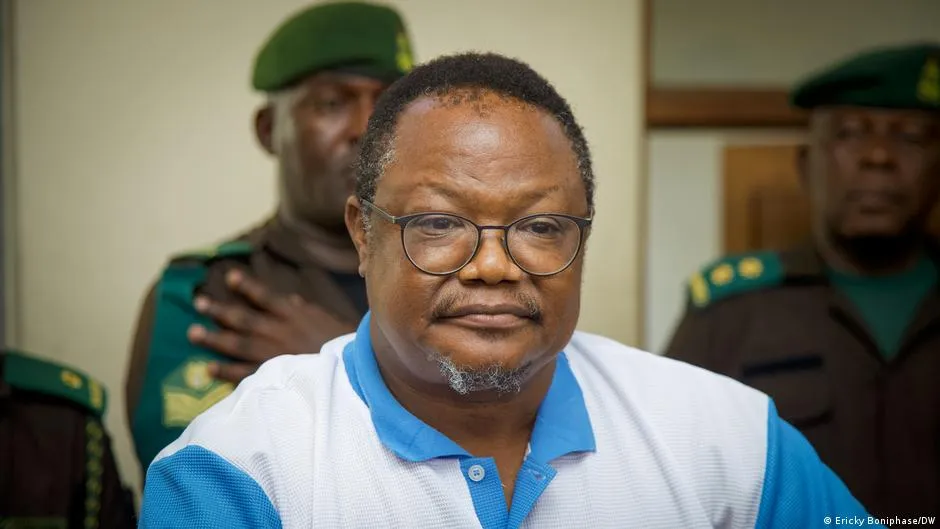
A Tanzanian court has sentenced opposition leader Tundu Lissu to four years in prison on a charge of incitement, while dismissing a treason charge that had carried the threat of the death penalty.
The three-judge panel in Dar es Salaam delivered the verdict on Friday in a trial that drew widespread international attention.
Lissu, 58, leads Chadema, Tanzania's main opposition party. He was arrested in April 2025 over a speech in which prosecutors alleged he told supporters the opposition would "block the election" and "mobilize rebellion." He pleaded not guilty, arguing his speech broke no law and that the prosecution was politically motivated.
"We are satisfied that through his statements, the accused intended to disrupt elections and instigate violence," one judge told a courtroom packed with Lissu's supporters. "We sentence you to four years in prison, but the doors are open for appeal," the judge added.
Lissu challenged the basis of his conviction, noting that incitement had not been among the original charges he faced.
"I was not charged with incitement but you judges are convicting me with it just to impress the person who gives you the titles. I believe these were directives," he said, in an apparent reference to President Samia Suluhu Hassan.
"All this was political persecution. Excuses were created to imprison me," he told the court after the verdict.
Lissu had already spent 19 months in detention before the ruling was handed down.
His arrest came as part of a broader wave of detentions and alleged abductions targeting government critics ahead of the October 2025 presidential election. Chadema was excluded from that vote, which Hassan was declared to have won with 98 percent of the vote.
The crackdown sparked large protests across the country. Security forces responded with lethal force in several cities. The opposition and rights groups put the death toll in the thousands. A commission appointed by President Hassan reported in April that at least 518 people had been killed and attributed responsibility to protesters. The government denied allegations that security forces used excessive force.
Security was heightened across Dar es Salaam and around the courthouse ahead of Friday's verdict, as Lissu's supporters gathered for the hearing.
The treason case drew criticism from British and European Union lawmakers, who described it as politically motivated and called for Lissu's immediate release.
"The use of capital punishment against a political opponent risks turning the justice system into an instrument of political repression," they wrote to President Hassan.
It marked the third high-profile treason trial in mainland Tanzania's history. The first two, in the 1970s and 1980s, involved defendants accused of plotting to overthrow and assassinate the country's founding president, Julius Nyerere.
This was the first time Lissu faced charges of this severity, despite having been arrested on multiple previous occasions. In 2017, he survived an assassination attempt in which he was shot 16 times, an attack he believes was politically motivated and which required him to undergo nearly 20 surgeries.