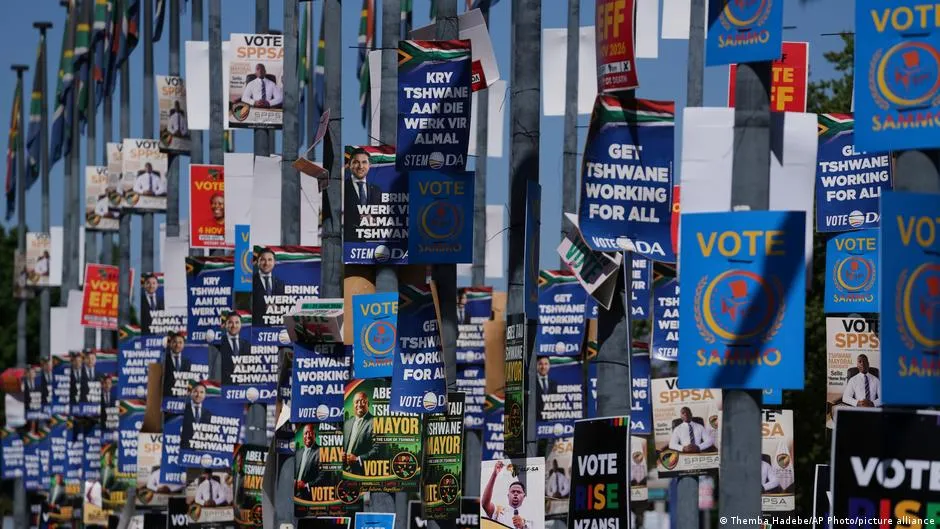
South Africa heads to the polls on Wednesday for municipal elections that will determine control of the country's largest cities and test whether the African National Congress continues its electoral slide.
The vote comes amid widespread frustration over failing basic services, with water shortages, unreliable electricity, and high crime rates among the central concerns for the country's 29 million registered voters.
In Tembisa, a township on the outskirts of Johannesburg, two women capture the divided mood. Vatiswa Zoya has decided to stay home. "We've decided not to vote. At all," she said two days before the election. "What is the point? We will still sleep hungry."
Twenty-two-year-old Lindokuhle Mbandazayo will go to the polls, though she has not yet decided which party to support. "When we vote for councilors, we ask them to fix the area," she said. "The electricity goes off regularly here. There is also sewage in the streets, and we have to jump over this. There are a lot of things that need to be fixed here."
Sanusha Naidu, an analyst at the Institute for Global Dialogue, described this as an "embedded frustration" that still drives people to vote. "Your vote actually puts some of these political parties' feet to the fire, but I think that frustration is also inherently coming from the fact that it's not going to happen overnight," Naidu said.
Water has emerged as one of the most pressing issues heading into election day. In Johannesburg, several neighborhoods have faced water cuts and rationing for weeks as ageing infrastructure struggles to meet demand. In Tshwane, the metropolitan area that includes the administrative capital Pretoria, a recent water treatment failure left more than 400 residents sick.
Ferrial Adam, executive director of water rights NGO WaterCAN, described the situation in stark terms at a protest over water cuts in Johannesburg. "Every province has an issue. So if we take for example drinking water quality, half of the drinking water systems in South Africa are not fit for drinking," she said. "Almost 70% of our wastewater treatment works are in a critical state and spewing sewage into rivers and streams across the country. It is a definite water crisis across South Africa."
Despite the severity of the problem, Naidu said many candidates have failed to offer concrete solutions. "I think their promises have been very transactional," she said. "Their promises are always, you know: 'We're going to bring water to your community. We're going to make sure the taps are flowing. We're going to ensure that we're going to deal with the old infrastructure around water, etc.' But I don't think they've dug deeper in terms of understanding what the budgets say about water access."
The ANC, which has historically held outright majorities in most municipalities, is facing its sharpest test yet. In 2016, the party secured 53.91% of the overall vote and held a majority in 161 of 213 councils. By 2021, that share had fallen to 45.59%, with a majority in 122 of 213 municipalities.
Global marketing research firm Ipsos predicts the party's support could fall as low as 30% in this election, which would result in a significant increase in coalition-run municipalities.
Naidu said the ANC has struggled to keep pace with the expectations of younger voters, particularly Millennials and Generation Z, who now make up the bulk of the electorate. "You have an electorate that wants to see who are these people that you're putting out there to say you're going to make things work for us," she said.
Mbandazayo, voting in her second election, said she was looking for a new political voice. "We need change," she said. "I am considering voting for another party."
Water shortages and unreliable electricity have become symbols of broader municipal failure, eroding support for the ruling party and, according to reports, shifting political loyalties ahead of Wednesday's vote.