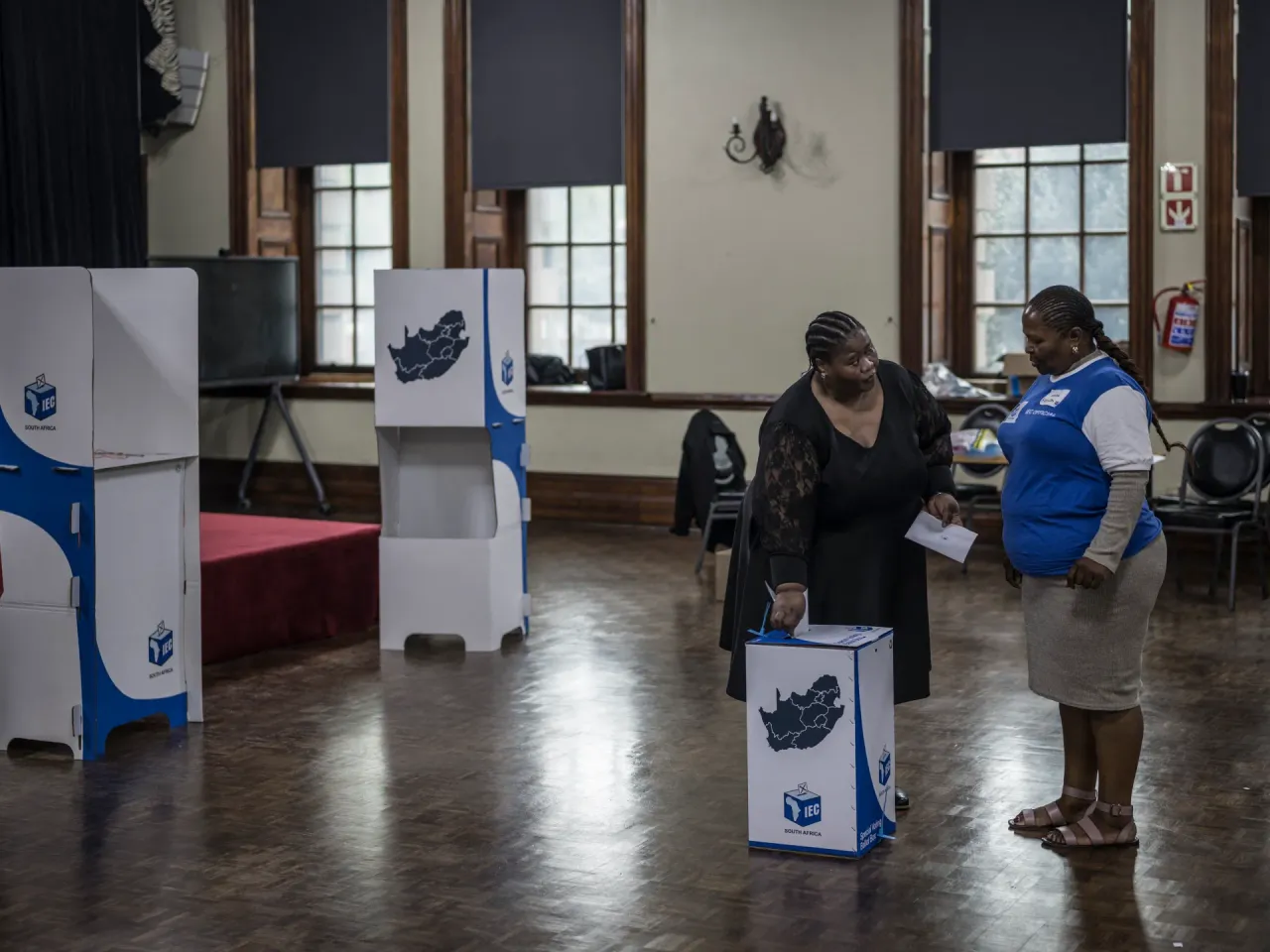
South Africans went to the polls on Wednesday in local government elections widely seen as a verdict on the ruling African National Congress, with corruption, crumbling infrastructure and failing essential services dominating the campaign.
A record 29.2 million people were registered to vote at 23,696 voting stations across the country, according to the Electoral Commission of South Africa. Polls opened at 7am local time and closed at 9pm. More than 1.4 million special votes had already been cast on Monday and Tuesday.
Voters were electing councils for eight metropolitan municipalities, 44 district councils and 205 local councils. Those councils then choose mayors.
The ANC, which led South Africa out of white minority rule in 1994, has been losing ground steadily. It fell below 50 percent in municipal polls for the first time in 2021. In the 2024 national election, it lost its parliamentary majority and entered a coalition government. Polls ahead of Wednesday's vote suggested its support could fall below 40 percent — with some surveys putting it at less than a third of the vote, compared with 45.6 percent at the last municipal elections and 40.2 percent in 2024.
"Municipal failures have contributed to declining public trust and confidence in democratic governance," President Cyril Ramaphosa said in his weekly newsletter. He was due to cast his own vote at Hyde Park High School in Johannesburg.
In Kensington, a Johannesburg suburb that has experienced repeated water and power outages in recent weeks, voters expressed frustration. "Service delivery is bad, it's horrible," said Tshepiso Makotse, 26, a call centre worker. "Water, electricity — everything, basically." She said she had split her two votes between the Democratic Alliance and the MK party, adding: "I just want change."
Terrence Pieters, a retired boilermaker, said: "The infrastructure in Johannesburg is shot." The 72-year-old declined to name the party he voted for but said he expected no single party to take control. "It's going to be a circus, it's going to be a coalition," he said.
Johannesburg, a city of 4.8 million people, has faced water shortages for more than a week and has had multiple mayors in recent years — figures vary between five in four years and ten in as many years, according to different reports. The neighbouring municipality of Ekurhuleni has had three mayors since 2021. In Tshwane, which contains the capital Pretoria, the mayoralty has rotated between parties four times since 2020. In October, more than 800 people contracted a gastrointestinal illness from contaminated water in Bronkhorstspruit, in east Tshwane.
The Democratic Alliance's Helen Zille, 75, is campaigning to become mayor of Johannesburg. Her campaign drew attention with stunts including snorkelling in a mud-filled trench flooded by a burst water pipe and kayaking along a flooded street. One poll put her at 36 percent, meaning she would need coalition partners to govern. She described the ANC as being "in free fall."
Zille is viewed with suspicion by some voters, particularly black voters, over past comments seen as appearing to excuse colonialism. Former Johannesburg DA mayor Herman Mashaba, who now leads ActionSA and is polling around 10 percent, has ruled out working with Zille and has called her a "racist" — an allegation she has consistently and firmly denied. The ANC, meanwhile, has three potential mayoral candidates for the city amid internal factional divisions.
In eThekwini metro, which contains the port city of Durban, former President Jacob Zuma's uMkhonto weSizwe party was polling above 40 percent. Zuma, 84, who has faced and denied numerous corruption allegations, is expected to draw heavily from his former party's support base. The ANC won 42 percent in eThekwini in 2021 and is now polling around 10 percent there. Durban has also become a focal point of anti-migrant sentiment, a prominent theme in the campaign. "We are going to start by taking back our country here," Zuma told supporters in the city on Sunday.
The DA looks set to retain its majority in Cape Town, though likely with less than the 58 percent it won in 2021, as concerns over unaffordable housing weigh on its support.
Coalition government is already widespread across the country. As of February, 74 of South Africa's 257 municipalities were run by coalitions or minority administrations, according to the Mapungubwe Institute for Strategic Reflection. Analysts point to the high turnover of coalition administrations as a major factor behind poor service delivery.
Turnout is also a concern. Only 46 percent of registered voters participated in the 2021 municipal elections.
Security was tightened ahead of the vote. Police recorded 21 election-related cases since Sunday. KwaZulu-Natal had 165 voting stations classified as high risk, the most of any province.
Final results are expected on Sunday. They are also expected to influence the race to succeed Ramaphosa as ANC leader at the party's conference in December 2027.


