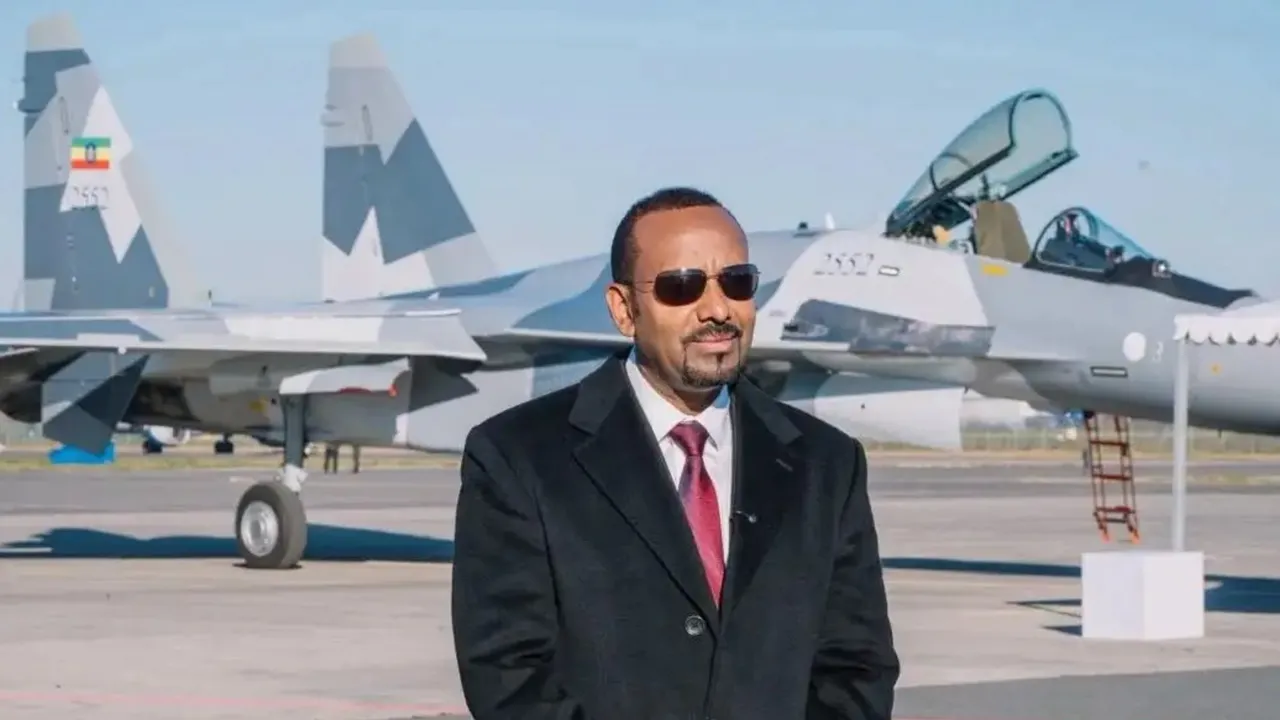
Ethiopia has received 12 Russian Su-35 fighter jets and plans to acquire four S-400 air defence batteries, Prime Minister Abiy Ahmed announced during the Russia-Africa Summit in Moscow.
Abiy said the aircraft were delivered ahead of schedule under an agreement signed with Russia several years ago. He described the acquisition as a "milestone" that would boost Ethiopia's defence capacity, adding that Ethiopia had now become the first country in sub-Saharan Africa to possess this type of advanced combat technology.
"If we fail to build this capability, surviving as a country in our region will become difficult. Countries with sufficient preparation are not easily defied," Abiy said.
He did not specify when the S-400 systems would arrive.
Russian President Vladimir Putin said in a statement: "I value the friendly relations between Russia and Ethiopia. Russia and Ethiopia stand together in international affairs." Putin also said bilateral trade exceeded $1.3 billion in January through September, more than double the figure recorded for all of 2025.
Abiy said his talks with Putin covered nuclear energy, health, trade, and bilateral and multilateral cooperation, in addition to the defence agreements.
The Su-35 is designed for both air-to-air and air-to-ground combat and is capable of detecting and neutralising incoming cruise missiles at distances of up to 200 kilometres, Abiy noted. The S-400 systems would complement the existing fleet by defending against aerial threats.
Benedict Manzin, a lead analyst on the Middle East and Africa at risk consultancy Sibylline, said the systems would be most effective against conventional air threats. "In a war with Eritrea, they could be used against Eritrea's limited air force and drones," he said. He cautioned, however, that conventional air defence systems have limitations. "As we have seen in Ukraine, conventional air defence systems can be overwhelmed by small, cheap drones," he added.
Military intelligence analyst Qalaab Segatu said Ethiopia's acquisition of additional warplanes was a key indication that "it was preparing for possible wars with other countries, not just internal conflicts." He said the jets are highly manoeuvrable, capable of covering large areas, and equipped with radars that enable long-range scanning and air superiority. When combined, the fighter jets and air defence systems "create a significant capability to protect and defend major cities and critical infrastructure such as the Renaissance Dam, providing key strategic air superiority," Qalaab said.
Abiy also stressed the importance of drones alongside the new aircraft. "We need to build capacity not only with drones, but also with the fourth generation capabilities of the Su 30 and Su 35 [aircraft]," he said. Ethiopia has previously used military drones sourced from Turkey and China in recent conflicts.
The announcements come as fighting has intensified in the northern Tigray region between the Ethiopian government and the Tigray People's Liberation Front. Both sides blame each other for violating a 2022 agreement that ended a civil war.
Ethiopia also accuses Eritrea of backing the TPLF, which Eritrea denies. Tensions between the two countries have persisted, with Abiy describing Ethiopia's lack of direct sea access as an "existential question." Eritrea, which gained independence from Ethiopia in 1993 following a decades-long war, views such statements as a direct threat to its sovereignty.
Russia and Ethiopia have maintained military ties for decades, rooted in Soviet-era support for Ethiopia's former communist government. The two countries signed a military cooperation agreement in 2021 covering technology and training. Experts say the current partnership serves both sides: Ethiopia gains military capability, while Russia secures arms revenue and diplomatic influence in the Horn of Africa.
"Russia is also in the business of making money through arms sales," Manzin said. "This is one of Russia's primary exports to Africa." He added that weapons sales sustain long-term relationships requiring training, maintenance, and replacement equipment.
Analysts say Ethiopia is broadening its partnerships rather than shifting exclusively toward Moscow. China maintains a significant economic presence in the country, and Western investment continues. Russia supplied 15 percent of African imports of major weapons between 2021 and 2025, behind the United States at 19 percent and China at 17 percent, according to the Stockholm International Peace Research Institute.
"African states are aware that they are a focus of geopolitical competition," Manzin said. "Everyone engages a bit, and Ethiopia tries to maximise its gains."