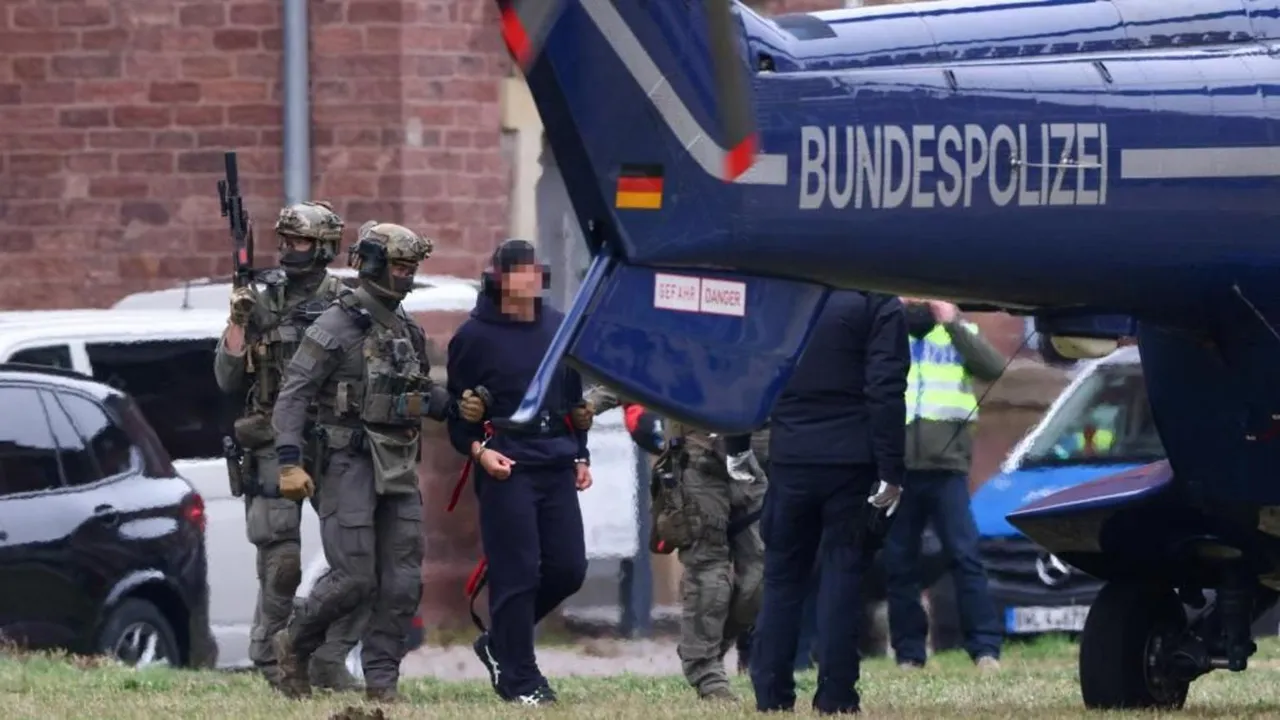
A Ukrainian former military officer went on trial in Hamburg on Wednesday, accused of organising the 2022 sabotage of the Nord Stream gas pipelines in the Baltic Sea.
The defendant, a 50-year-old identified under German privacy rules as Serhii K. and named in extradition documents as Serhii Kuznetsov, is the first suspect to face trial over the blasts. He denies the charges.
The trial opened at the Hamburg Higher Regional Court and is expected to run into February next year.
Prosecutors accuse Kuznetsov of being a serving officer in the Ukrainian army at the time of the attack and of leading a group that included four deep-sea divers, an explosives expert and a ship's captain. The group is alleged to have used a rented yacht, sailed from the northern German city of Rostock, and attached military-grade explosives fitted with timers to the pipelines on the seabed near the Danish island of Bornholm.
Prosecutors allege he detonated at least four incendiary devices of up to 27 kilograms in weight at a depth of approximately 80 metres. They say he travelled to Germany through Poland on a forged Ukrainian passport roughly three weeks before the attack.
On 26 September 2022, Swedish seismologists detected several blasts, some 17 hours apart. Three of the four concrete-coated steel pipelines ruptured, releasing large plumes of methane into the atmosphere.
The explosions badly damaged Nord Stream 1, which had been Russia's main gas supply route to Germany before Moscow cut supplies in August 2022. They also damaged Nord Stream 2, which had been built but never put into operation after Germany suspended its authorisation process shortly before Russia's full-scale invasion of Ukraine.
German prosecutors have characterised the attack as a war crime, arguing that targeting civilian infrastructure in this manner violates international law. In July, German state prosecutors stated that Ukrainian "state authorities" had ordered the attack, with the aim of permanently halting gas supplies and preventing Russia from using gas revenues to finance its war effort.
Ukraine's government, including President Volodymyr Zelenskyy, has denied any involvement. Oleksandr Merezhko, who chairs the Foreign Affairs Committee in the Ukrainian parliament, said the blasts occurred during a time of war with Russia and that "Nord Stream 2 was nothing but a tool used by Russia in order to get prepared for the war." He added that Kyiv had no confirmation of the German account, describing it as "one of the versions."
Russia has also denied responsibility for the blasts and said on Monday it expected a "just verdict" naming the perpetrators and those who ordered the operation. Western suspicion initially pointed toward Moscow in the months following the attack, though no direct blame was formally assigned at the time.
Kuznetsov was arrested in August 2025 while on a family holiday in Italy, reportedly travelling on a false passport. He surrendered without resistance. After legal efforts to block extradition failed, he was transferred to Germany in November 2025.
A second suspect, identified as Volodymyr Zhuravlov or Vladimir Z. in various court documents, was arrested in Croatia in August on suspicion of having participated in the dives required for the sabotage. He denies any involvement and has applied for asylum in Croatia. Last month, a Croatian court approved his extradition to Germany, though the timing and whether his case will be joined to the Hamburg trial remains unclear.
A third Ukrainian man, Volodymyr Zhuravlov, had earlier successfully challenged a German extradition request in a Polish court. In October 2025, a Polish judge ordered his release, ruling that the pipeline attack was not unlawful and that, if Ukraine had organised the mission, it was "justified, rational and just."
The trial is being closely watched in both Berlin and Kyiv. Germany has declined to comment officially, and analysts say successive German governments have sought to keep the case out of the political arena. Stefan Meister of the German Council on Foreign Relations said officials had tried to handle it through judicial channels. "They tried to make not a big story out of it, not to give it too much attention, to give it to the institutions, to the judiciary that they will deal with it. This is not a political case. So they tried to depoliticise it," he said.
Despite the sensitivity of the case, Ukrainian MP Merezhko said he did not believe it would damage relations between the two countries, as "it's in the best national interests of Germany to continue to support us."
The trial has nonetheless provided political ammunition to the far-right Alternative fur Deutschland party, which has used the Nord Stream affair to argue that German aid to Ukraine should end and that the pipeline should be reinstated to ease energy costs.