Switzerland's glaciers have suffered a near-record loss of ice in 2026, with new monitoring data showing that 5.5% of the country's remaining glacier volume disappeared in the first eight months of the year.
The reduction falls just short of the record set in 2022 and brings the total loss of glacier ice since 2021 to 19.4% — nearly one-fifth of Switzerland's ice gone in five years.
The findings come from an annual report produced by the Swiss Glacier Monitoring Network in collaboration with the Swiss Commission for Cryosphere Observation. Scientists described the scale of loss as "extraordinary" and "disastrous."
"It's really just disastrous," said Dr. Matthias Huss, director of Glacier Monitoring Switzerland and lead author of the report.
The losses were driven by a summer of intense heatwaves following a winter with little snowfall. Analysis published by MeteoSwiss found that the summer half-year, from April to September, was the hottest and driest since records began in 1864.
The mean thickness of individual glaciers fell by between 2.5 metres and 4 metres during the year. At some sites, scientists recorded 4 metres of ice loss even at the highest elevations, where glaciers are typically protected by deep winter snow cover.
Even at altitudes of 3,500 metres above sea level, no snow remained at the end of summer — a finding researchers described as particularly alarming.
"At some glaciers we've seen four metres of ice loss at the highest point, where they should be covered by several metres of winter snow at this time of the year," said Huss.
Snow acts as a replenishment source for glaciers. When none survives the summer, it cannot replace the ice lost to melting at lower, warmer elevations. Without that input, glaciers shrink and eventually disappear.
"Glaciers are complex because they gain mass at the top and they flow downstream, so there is a lot of physics," one scientist explained. "But in its simplest form, what we see right now is that we took an ice cube out of the fridge and it's just melting in front of our eyes."
Until recently, glaciologists in the Alps considered a 2% annual ice loss to be extreme. The 2026 figure of 5.5% is nearly three times that threshold.
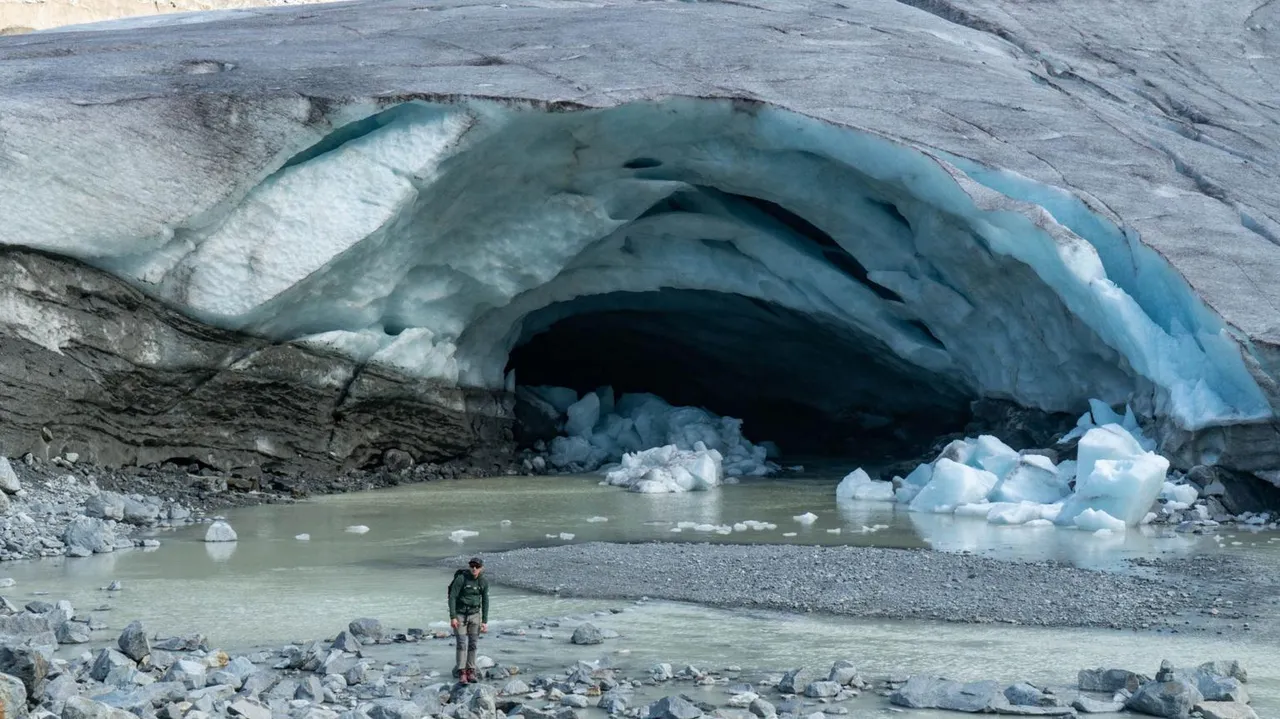
Huss said scientists are increasingly observing glaciers collapsing from the inside, driven by internal meltwater streams that carve out caverns beneath the ice surface.
"You have huge holes like cheese in the middle of the ice that have collapsing roofs," he said. "These are processes that tear the glaciers apart and make them retreat even faster."
Europe is warming at roughly twice the global average rate, with Alpine regions among the most severely affected. Scientists attribute the acceleration to heat-trapping fossil fuel emissions and the destruction of natural ecosystems.
Despite summer temperatures exceeding those of 2022, ice loss in 2026 narrowly missed the record set that year. Researchers attributed this to limited deposits of Saharan dust — which darkens snow and reduces its ability to reflect sunlight — as well as slightly greater snow cover at the end of winter.
Huss visited the former Plattalvafirn, also known as the Griess glacier, in September. Once covering an entire mountain flank, it has lost 99% of its area in just 20 years. The glacier was among the most closely monitored in the world during the 1950s.
"I visited one last week and it's so impressive to stand in this moonlike landscape where there was a big layer of ice — an extensive glacier — just a few years ago," said Huss. "And now it's a rock desert where there's some scattered blocks of old ice still lying around and melting on the hot rocks."
"What was different at that time is that the rates of retreat were still kind of at a normal level," he added, referring to the data he worked with as a PhD student. "What we are seeing now is a complete explosion of these melt rates, leading to the disintegration of glaciers. They're really just falling apart."
Scientists warn that the rapid loss of glacier ice poses long-term risks to water supplies used for farming, hydropower and transport. Glacier thinning also destabilises mountain slopes, raising the risk of landslides and, in extreme cases, flash flooding.