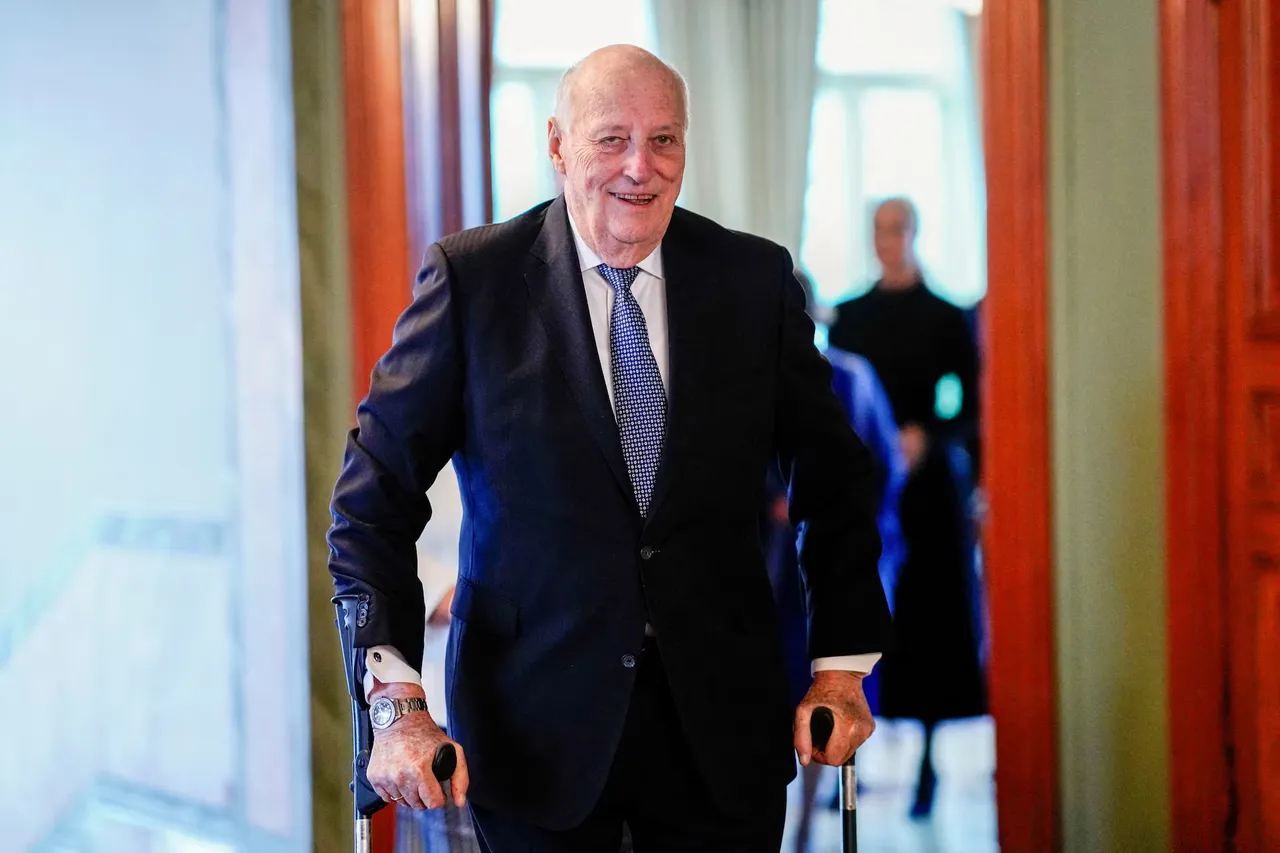
Norway's King Harald, who modernized the monarchy during more than three decades on the throne, died on Friday at the age of 89, the royal palace said.
"King Harald passed away peacefully at Oslo University Hospital on Friday 28 August, 0635 (local time, 0435 GMT)," the palace said in a statement.
Harald, Europe's oldest living monarch, had been hospitalized since August 17 while receiving treatment for a bacterial infection in his blood.
The king had faced several health problems in recent years. In 2024, he was hospitalized with an infection while on holiday in Malaysia, where he received a temporary pacemaker. He was later fitted with a permanent device after returning to Norway.
Harald became Norway's ceremonial head of state in 1991 following the death of his father, King Olav V. In 2024, he announced that he would reduce his official engagements but ruled out abdication, saying his oath as king was for life.
A Popular King in Times of Crisis
Harald remained widely popular among Norwegians throughout his reign and became a prominent symbol of national unity during times of crisis.
After far-right extremist Anders Behring Breivik killed 77 people in Oslo and on Utøya island in 2011, Harald delivered an emotional televised address in which he urged Norwegians to respond with tolerance and said that "freedom is stronger than fear."
He also regularly visited communities affected by floods, storms and other disasters, often meeting victims in person.
In a 2016 speech, Harald spoke in favor of tolerance and said Norway could include people with different backgrounds, beliefs and sexual orientations.
He also introduced a more open and modern approach to the monarchy, arguing that royal families should not retreat behind palace walls.
"If you've opened the gate it's very difficult to close it again," he said in a 2005 interview. "I'm not sure I'd want to close it."
A Life Shaped by War
Harald was born on February 21, 1937, the first royal heir to be born in Norway in almost 570 years.
When Nazi Germany invaded Norway in 1940, his father, then Crown Prince Olav, and grandfather, King Haakon VII, fled to Britain to lead the government-in-exile. Harald, then three years old, left Norway with his mother and sisters, eventually spending several years in the United States.
He returned to Norway in 1945 and later attended state schools, breaking with the educational tradition followed by his father.
In 1968, Harald married Sonja Haraldsen, a commoner, after a nine-year dispute with his father over the relationship. The marriage marked a significant break with royal tradition.
Harald was also an accomplished sailor and competed in three Olympic Games. He later captained his boat to a world championship title and remained passionate about sports, automobiles and nature.
Challenges for the Royal Family
Harald's death comes during a difficult period for the Norwegian royal family.
Crown Princess Mette-Marit, the wife of Harald's son and heir Crown Prince Haakon, has faced scrutiny over her past friendship with convicted sex offender Jeffrey Epstein. She has apologized for the relationship.
Her son Marius Hoiby, from a relationship before her marriage to Haakon, was convicted in June of two counts of rape and one count of domestic violence and sentenced to four years in prison. Both Hoiby and prosecutors have appealed the sentence.
The monarchy has also faced declining public support. A Norstat poll published by Norwegian public broadcaster NRK put support for the monarchy at 60% in February 2026, although it rose to 64% in May.
Harald himself remained highly regarded. In the February poll, he received a rating of 9.2 out of 10 for representing the Norwegian royal family.
Haakon to Become King
Harald is succeeded by his son, Crown Prince Haakon, who will become Norway's fourth king since the country's independence from Sweden in 1905.
Haakon, 53, will become king alongside his wife, Mette-Marit, also 53.
The Norwegian monarchy now enters a new era as Haakon takes the throne following his father's 35-year reign.