French President Emmanuel Macron has accused Donald Trump and other foreign leaders of making "stupid comments" about France's street unrest for political gain, as the country prepared for further protests this weekend.
Speaking during a visit to Qatar, Macron did not name names but said "manipulation of information" following Saturday's riots had led to "comments that are as unacceptable as they are stupid, from many people, including foreign leaders."
Asked directly whether he was referring to Trump, Macron replied: "Among others."
He said some leaders "in the middle of election campaigns, whether here in the region or on the other side of the Atlantic" were "naively spreading narratives that certain circles are clearly trying to promote" and were "using our country for their own political campaigns."
"We don't need that. We already have difficulties to deal with," he added.
Macron said AI-generated images were circulating "depicting scenes that never actually happened in France." He added: "We've had people claiming that we were invaded by hordes of migrants and Islamists, which is completely false."
Trump, who is campaigning for his Republican party ahead of midterm elections next month, blamed France's violence on mass immigration. "When I look at France, when you look at Italy, when you look at all the turmoil and the hatred, that's not about school," he said. "That's about people coming into the countries that hate the country."
"Close your borders and take control before it is too late!" Trump said in remarks directed at Macron.
Israeli Prime Minister Benjamin Netanyahu, who faces parliamentary elections next week, also said France had been hit by an "invasion of extremist Islam." He said he had told Macron after the Hamas attack on Israel on 7 October 2023: "If we do not eliminate them here, you will have them in Paris." "That is exactly what is happening," he added.
Analysts have dismissed claims that migrants were the main factor in France's protests.
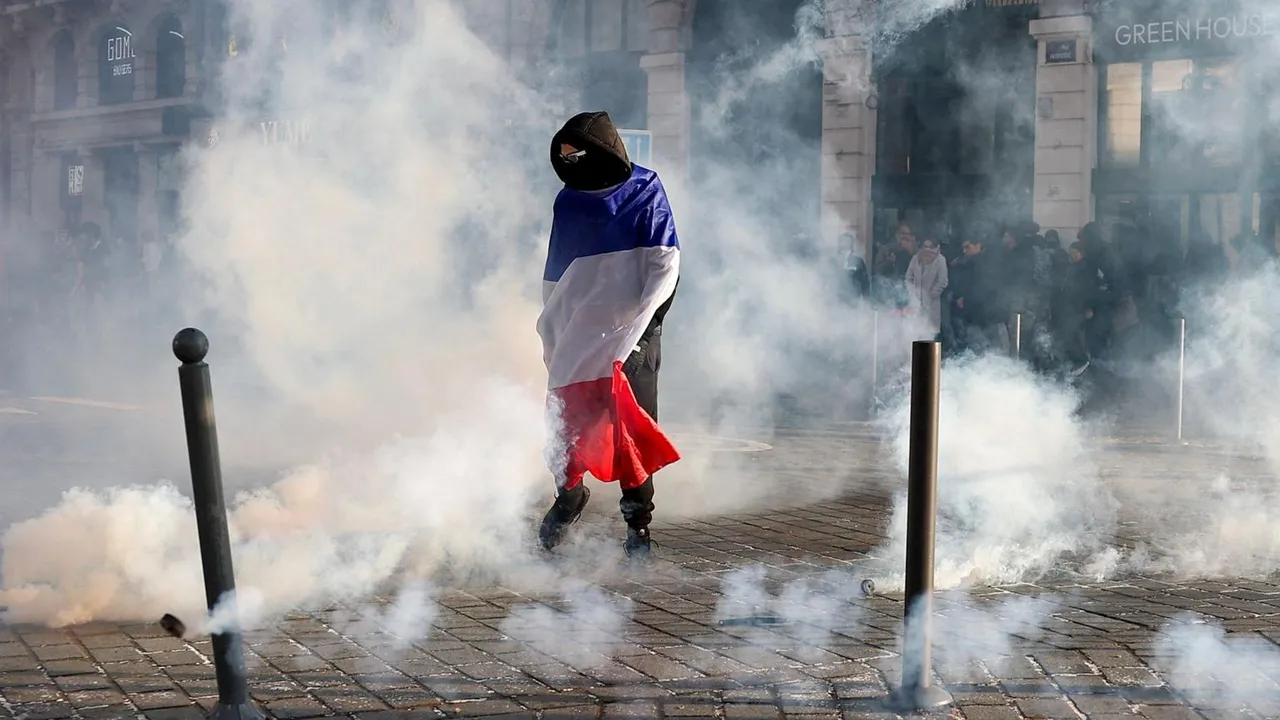
The unrest began when largely peaceful demonstrations over the cost of living descended into widespread violence and looting in cities including Paris, Marseille, Lyon, Limoges and Lille. The town hall in Limoges was set on fire and partly destroyed.
The government admitted the police had "lost control" during the violence. Nearly 150 people have been jailed and more than 800 brought before the courts since the riots erupted.
The unrest has prompted several countries to issue travel warnings for France and rattled financial markets. The yield on French government benchmark 10-year bonds passed 5% on Wednesday, its highest level since 2002.
Macron vowed that authorities would be "uncompromising" towards what he described as agitators from ultra-left fringe groups, which he blamed for much of the trouble. "Those who want to cause disorder in city centres next Saturday will be prevented from doing so," he said.
Government ministers have promised a "massive" and reinforced security operation, with some troops expected to be deployed alongside police. Partial night-time curfews imposed in areas prone to violence in cities including Paris, Marseille and Lille were expected to be renewed.
The gilets jaunes movement has formally filed plans for a march through central Paris on Saturday, aiming to revive their 2018 campaign against rising living costs and declining public services. Student groups have also called for protests the same day to demand greater investment in education.
France's main trade unions have separately called a nationwide mobilisation for 5 November. Sophie Binet, head of the CGT union, said: "There is huge and legitimate anger, and the answer to that situation is not repression. It is a political response."
Union representatives met Prime Minister Sebastien Lecornu on Wednesday, but no concrete announcements followed.
EU regulators are reported to be examining possible foreign online interference and disinformation campaigns linked to the French riots and similar recent unrest in other EU states. Unnamed security officials were quoted as saying that pro-Russian and far-right social media accounts linked to previous disinformation campaigns had spread violent videos in an attempt to sow further chaos. Iran and Algeria are also reported to be suspected of involvement in some of the messaging.
A researcher at France's Sciences Po university specialising in disinformation was quoted as saying that pro-Kremlin influencers linked to the Russian campaign known as Storm-1516 had "amplified the events and spread a number of false narratives."
Separately, more than 15 examples of fake news videos on social media have been reviewed and attributed by researchers to a Russian disinformation operation known as Matryoshka. The videos feature near-identical branding to real French news outlets. Experts said the focus on amplifying unrest is consistent with known Russian disinformation tactics.
Macron insisted France "doesn't need a state of emergency," saying it "has the means" to control any further unrest.