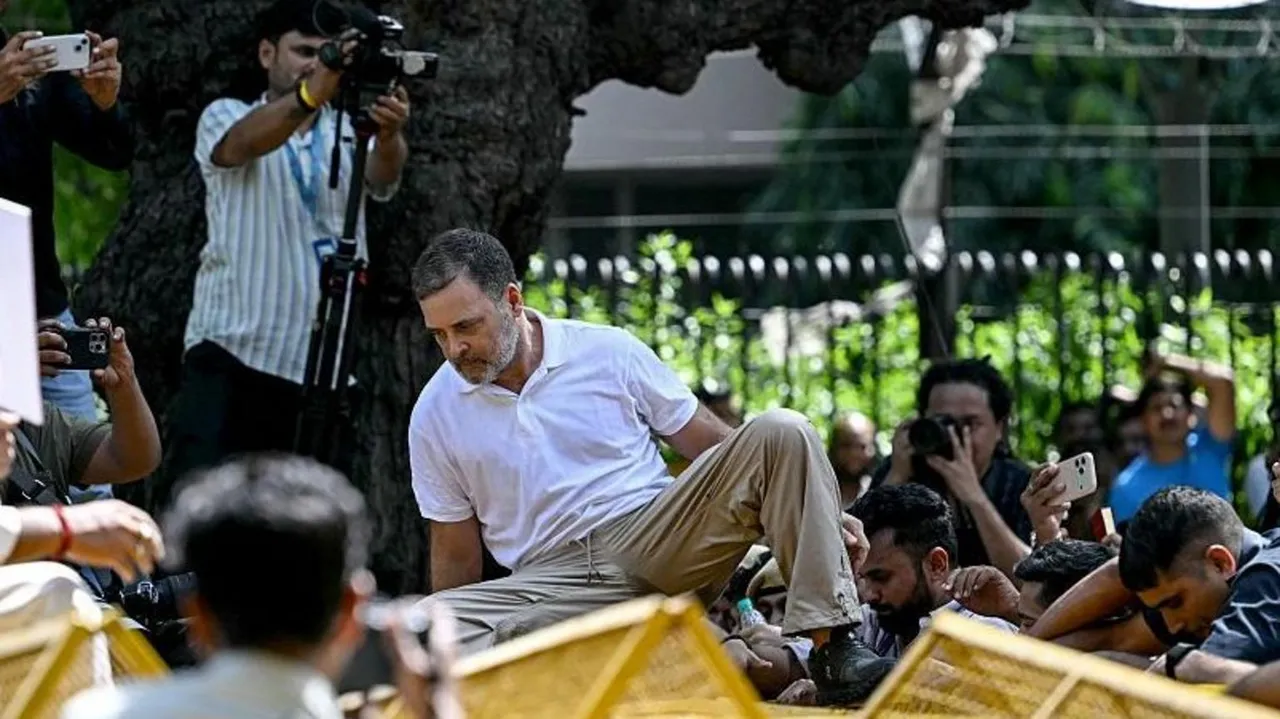
Police in New Delhi briefly detained several opposition lawmakers on Tuesday during a protest march demanding the resignation of Chief Election Commissioner Gyanesh Kumar.
Rahul Gandhi, leader of the opposition in India's lower house of parliament, was among those detained but was released shortly after, according to reports.
The march, roughly one kilometre long, led from parliament to the Election Commission headquarters through the centre of New Delhi. Lawmakers carried placards, waved the national flag and shouted slogans against Kumar along the route.
Security was tightened around the Election Commission building, with police barricading roads along the route. "Some of the MPs tried to take some other roads to the Election Commission building. We have officers stationed at multiple points, from where the protesters were picked up in buses and taken to different police stations," Additional Deputy Commissioner of Police Manjeet Sheoran said. Police did not disclose how many lawmakers had been detained. The opposition said 237 MPs from a range of parties participated in the march.
At the centre of the controversy is the Election Commission's Special Intensive Revision (SIR) of electoral rolls. The exercise began in the eastern state of Bihar in June 2025 before being expanded to most states and federally administered territories.
The Election Commission says the revision is intended to remove duplicate, deceased or ineligible voters from electoral rolls. On Friday, it directed officials to register eligible voters inadvertently omitted from the lists. More than 130 million names have so far been removed from draft voter lists nationwide, and commission data shows rolls could shrink by as much as 30 percent in some regions.
Opposition parties and activists allege that many eligible voters have been wrongly excluded, accusing the poll body of conducting the process improperly. Critics say the process requires documents that are confusing and difficult to obtain, risking the exclusion of millions of eligible voters.
Congress President Mallikarjun Kharge described three demands as non-negotiable: Kumar's resignation, cancellation of the SIR exercise and a return to paper ballot voting. "The election commission is a puppet in the hands of the government," Kharge told reporters as the march began.
Mocking the election chief, Gandhi posted on social media: "Gyanesh, it's done, bro. Time to resign."
The BJP condemned the protests. BJP spokesperson Sambit Patra described them as a "sponsored attempt" to bring about a change of power through "anarchy" and accused opposition parties of seeking to undermine constitutional institutions. "After failing multiple times, Congress leaders have decided to establish anarchy in the country and attack institutions," Patra told reporters before Tuesday's protest.
The campaign against Kumar gathered momentum after an investigation by an Indian newspaper reported that election commissioners Sukhbir Singh Sandhu and Vivek Joshi had formally objected at least 14 times over a 10-month period to decisions and orders they said had been issued in the Election Commission's name without their knowledge. The objections related to issues including additions and deletions from voter rolls, access to the voter database and the security of electoral data. Some concerns were linked directly to the electoral roll revision programme.
The Election Commission, a three-member body comprising the chief election commissioner and two election commissioners, defended its decision-making process, saying differing views were part of institutional functioning and that decisions had ultimately been taken unanimously.
The controversy has also reached India's Supreme Court, which has asked both the federal government and the Election Commission to respond to a petition alleging that Kumar took key decisions without the approval of the two other election commissioners. The petition argues that Kumar exercised powers belonging collectively to the commission and seeks a ruling that any such actions were unauthorised.
The court indicated that Election Commission decisions must be taken either unanimously or by majority vote and suggested that decisions could be set aside if found to have bypassed that process. It declined, however, to suspend Kumar at this stage, saying it would first hear the Election Commission's response and examine relevant records.
Tuesday's protest came four days after a Gen Z-backed online satirical movement organised demonstrations in Mumbai and Delhi, also demanding Kumar's resignation. That group has described those demonstrations as the beginning of a nationwide campaign and has called for another round of protests on 10 October.